
First Light News: Oil pushes higher, Powell digs in, ECB and BoE on deck

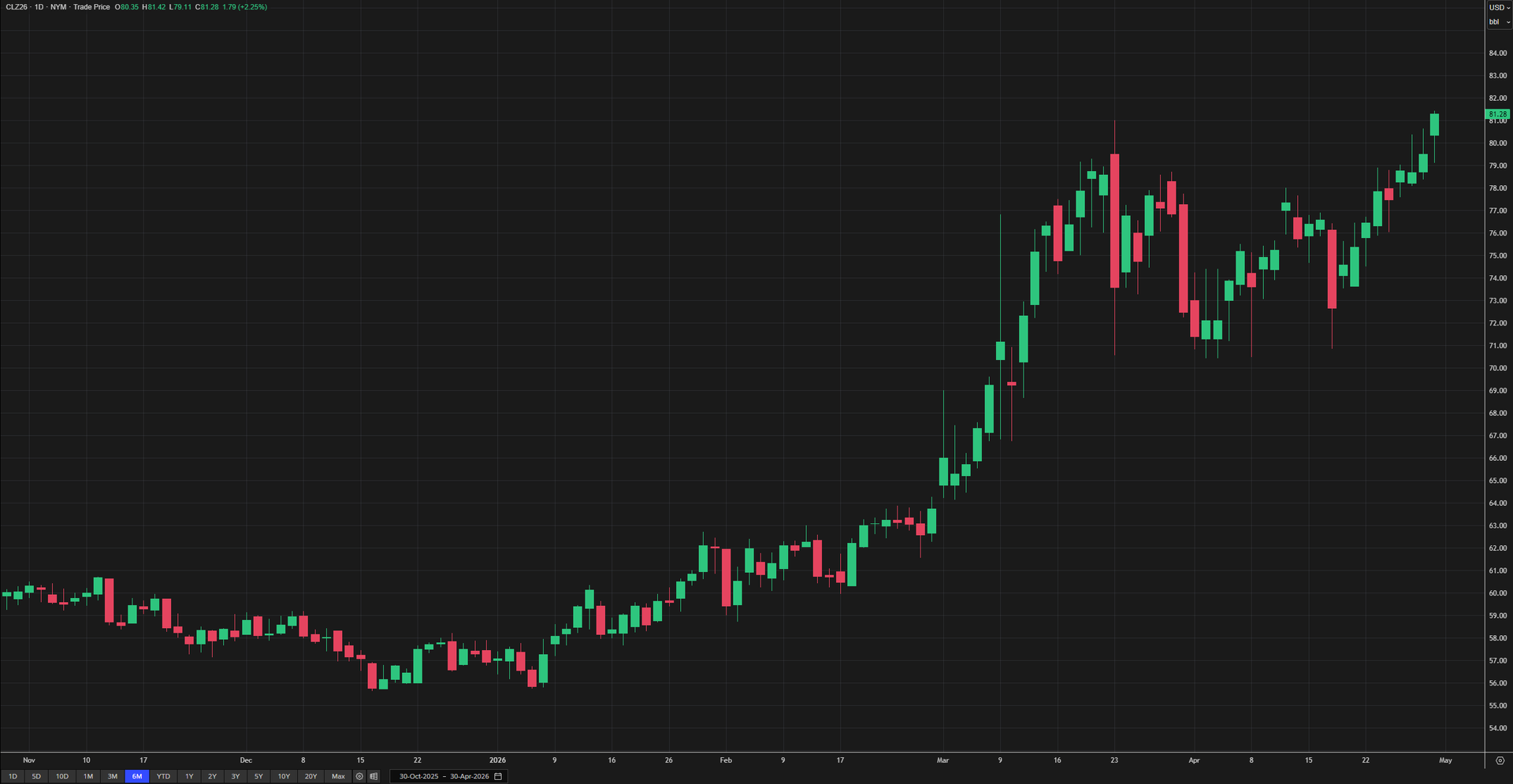
Kicking off with oil prices, both Brent and WTI spot prices wrapped up Wednesday’s session at highs, adding 7.7% and 8.9%, respectively. The Strait of Hormuz has remained all but closed since the onset of the US-Iran conflict in early March, with reports that the US is preparing for an extended blockade. Oil markets also caught a modest bid overnight amid reports that President Trump is expected to receive a military briefing on possible Iranian strikes, per Axios.
Suffice it to say, prospects for a resolution remain dim at this point. Interestingly, the WTI December 2026 futures contract recorded a fresh record high yesterday, suggesting the market is not pricing in a speedy resolution.
That man is not going anywhere
The April Fed meeting concluded yesterday, with Jerome Powell chairing his final meeting. It was no surprise to see the central bank keep the funds target rate on hold at 3.50-3.75%. What did raise some eyebrows, however, was the 8-4 vote split. Governor Stephen Miran voted to lower the rate by 25 bps, while three Presidents – Beth Hammack, Neel Kashkari, and Lorie Logan – banded together to support maintaining the target, though they dissented from the easing-bias language in the statement. This marks the highest level of dissent since the early 1990s, as the Fed remains caught between a rock and a hard place, balancing elevated inflation and a gradually loosening jobs market.
The April Fed meeting concluded yesterday, with Jerome Powell chairing his final meeting. It was no surprise to see the central bank keep the funds target rate on hold at 3.50-3.75%. What did raise some eyebrows, however, was the 8-4 vote split. Governor Stephen Miran voted to lower the rate by 25 bps, while three Presidents – Beth Hammack, Neel Kashkari, and Lorie Logan – banded together to support maintaining the target, though they dissented from the easing-bias language in the statement. This marks the highest level of dissent since the early 1990s, as the Fed remains caught between a rock and a hard place, balancing elevated inflation and a gradually loosening jobs market.
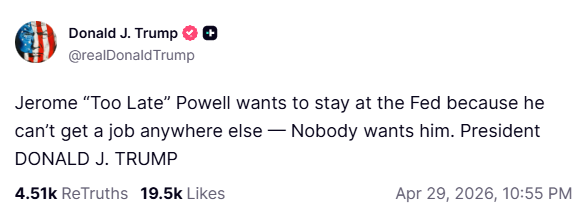
Powell then confirmed he will remain on the Fed’s Board of Governors after his chairmanship ends on 15 May, citing ongoing legal threats to the institution as his reason. Kevin Warsh’s Senate confirmation also advanced this week, but he will inherit three hawkish dissenters and a Fed that the market has already priced with no cuts this year. Powell staying put also means that Trump does not get to fill that seat, which is itself a political variable worth watching. Unsurprisingly, Trump was quick to respond with a short but direct Truth Social post:
For the USD, the Fed decision proved modestly supportive, with markets completely removing 2026 easing from the rates curve and currently pricing in 3 bps of tightening.
Big tech earnings
Wednesday’s tech earnings deluge was revealing.
Wednesday’s tech earnings deluge was revealing.
Alphabet (GOOG) was clearly the standout report, with Google Cloud hitting US$20 billion in quarterly revenue, which was comfortably ahead of estimates. As a result, the company’s share price caught a bid in after-hours trade.
Meta (META) had a rougher ride. Full-year cap-ex guidance was raised to as much as US$145 billion, partly due to rising component prices. I do not think it is about the number so much; it is more to do with the fact that the company does not have a cloud business to point to as justification. Its standalone AI app has not gained the traction investors hoped for, and CEO Mark Zuckerberg’s answers to analyst questions were – to use his own words – ‘unfulfilling’. On the back of this, the META stock took a hit.
Results from Amazon (AMZN) and Microsoft (MSFT) were more mixed. AWS grew 28% YY – the fastest in three years – while Microsoft guided to 40% Azure growth in the current quarter. Neither company offered much to get excited about, but neither disappointed enough to warrant undue concern.
ECB and BoE: hold eyed
Today brings decisions from both the ECB and the BoE, which are expected to leave the deposit rate at 2.0% and the Bank Rate at 3.75%, respectively. Markets are currently pricing in 87 bps of ECB tightening by year-end (three rate hikes), with a similar picture for the BoE at 79 bps. The focus will not be so much on the decisions themselves, but on what the central banks have to say.
Today brings decisions from both the ECB and the BoE, which are expected to leave the deposit rate at 2.0% and the Bank Rate at 3.75%, respectively. Markets are currently pricing in 87 bps of ECB tightening by year-end (three rate hikes), with a similar picture for the BoE at 79 bps. The focus will not be so much on the decisions themselves, but on what the central banks have to say.
For both central banks, I will be watching for any pushback against current rate pricing and the tone on inflationary pressures, which could reaffirm wait-and-see stances and weigh on respective currencies. Put simply, I see very little that would tempt them to hike at the upcoming meeting; members are in the dark as much as investors are about how long the Middle East conflict will last.
I do want to add that the BoE will also be releasing its first complete set of updated quarterly forecasts since the US-Iran conflict began. The focus will be on inflation numbers. Inflation at 3% by year-end is unlikely to justify three hikes; we would need to see a number north of that for rate hikes to be more likely. The vote split could also be interesting. You will recall that the March meeting saw the MPC vote unanimously to keep the bank rate at 3.75%. Even the most uber dovish member, Swati Dhingra, voted to stay put. Current estimates suggest an 8-1 split in favour of a hold, but a 7-2 split is also possible as some could vote for a hike. Of course, a more even split would grab the market’s attention, with this underpinning a GBP bid – a move that could be further fuelled by the fact that positioning is modestly overstretched to the downside.
To sum up, I feel it is less about what both the ECB and BoE do today and more about how they frame the current/future situation, with a shift in emphasis that could reshape market pricing.
Written by FP Markets Chief Market Analyst Aaron Hill
Publication date: