US Dollar Surges As Middle East Tensions Spur Oil Prices. Forecast as of 20.06.2025

The United States is a net exporter of energy commodities. Rising oil prices are beneficial to the US dollar, and Donald Trump's decision not to strike Iran for two weeks has led to a de-escalation of the conflict. Let's discuss these topics and make a trading plan for the EURUSD pair.
Major Takeaways
The US dollar is benefiting from soaring Brent prices, as it is the currency of an exporting country.
European central banks are cutting rates across the board.
De-escalation of the conflict in the Middle East is helping the euro.
Long trades can be opened if the EURUSD pair breaks above 1.153.
The US dollar is benefiting from soaring Brent prices, as it is the currency of an exporting country.
European central banks are cutting rates across the board.
De-escalation of the conflict in the Middle East is helping the euro.
Long trades can be opened if the EURUSD pair breaks above 1.153.
Weekly US Dollar Fundamental Forecast
Donald Trump has gained notoriety for employing tactics of negotiations at gunpoint. This is not merely a matter of trade wars, where the US administration initially imposes excessively high tariffs and subsequently reduces them in exchange for concessions. The strategy is being transferred to geopolitics. The US president has stated that he will make a decision regarding potential strikes against Iran within the next two weeks. He granted Tehran an opportunity to resume negotiations regarding its nuclear program, prompting Brent to retreat and boosting the EURUSD pair.
Donald Trump has gained notoriety for employing tactics of negotiations at gunpoint. This is not merely a matter of trade wars, where the US administration initially imposes excessively high tariffs and subsequently reduces them in exchange for concessions. The strategy is being transferred to geopolitics. The US president has stated that he will make a decision regarding potential strikes against Iran within the next two weeks. He granted Tehran an opportunity to resume negotiations regarding its nuclear program, prompting Brent to retreat and boosting the EURUSD pair.
Generally, trade wars tend to spur inflation in countries that impose tariffs. Meanwhile, a slowdown in GDP growth is common for countries against which import duties are imposed. In the case of oil, however, the situation is entirely different. The Brent rally is driving inflation worldwide. As a result, the economies of net exporters are experiencing an acceleration, while those of net importers are exhibiting a deceleration. The United States is a net supplier of energy commodities, and the ongoing conflict in the Middle East is creating tailwinds for the US dollar and headwinds for the euro.
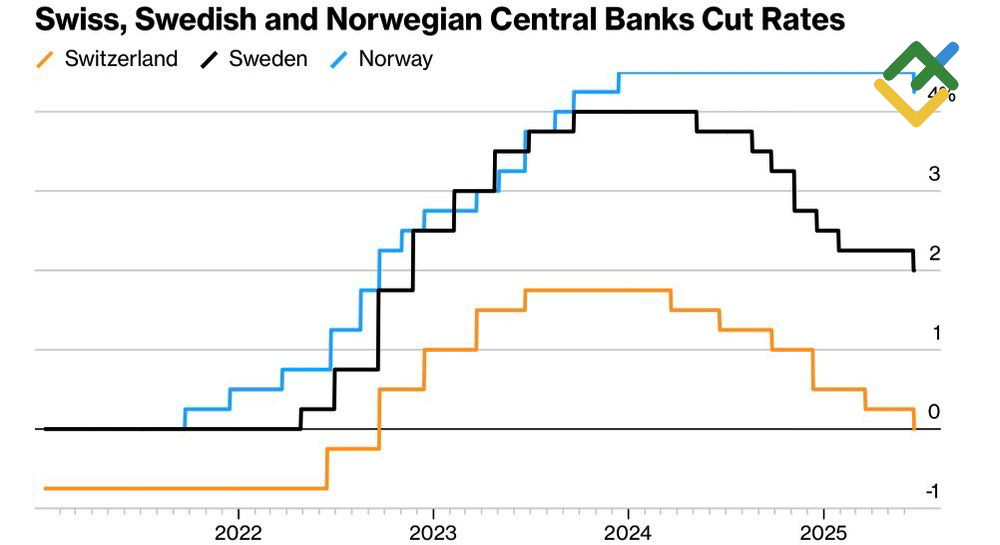
Central Banks' Interest Rates
Source: Bloomberg.
Source: Bloomberg.
Therefore, the EU economies are facing dual challenges in the form of trade wars and escalating geopolitical tensions. Their central banks are attempting to provide support through lower interest rates. Sweden, Switzerland, and Norway have followed the ECB in adopting this approach.
It is reasonable to interpret Donald Trump's two-week delay in returning to the negotiating table on Tehran's nuclear program as a de-escalation. The US has not initiated an immediate attack on Iran and has made it clear that the conflict can be resolved through diplomatic means. Furthermore, the financial impact of the conflict on Israel is significant. If it were to end today, Jerusalem would require at least $400 million to restore its infrastructure.
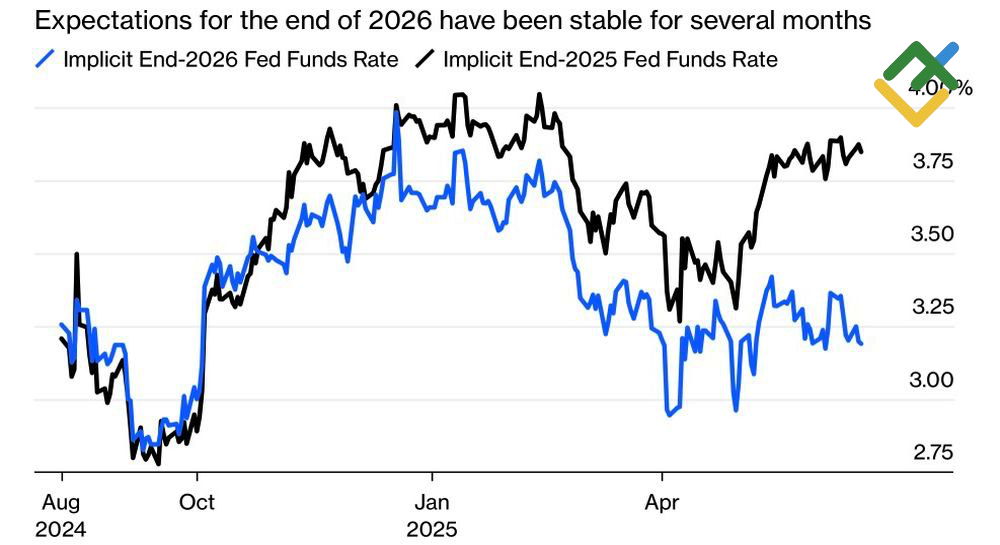
The decline in oil prices mitigates the risk of US inflation accelerating. The expectation of an increase in consumer price growth has informed the decision of seven FOMC members to keep the federal funds rate unchanged in 2025. The derivatives market is also gradually embracing this shift, adjusting its expectations for the resumption of the Fed's monetary expansion cycle to next year.
Market Expectations on Fed Interest Rate
Source: Bloomberg.
Source: Bloomberg.
The Israeli-Iranian conflict has led to a resurgence of interest in the US dollar as a safe-haven currency, as the epicenter of events is located in the Middle East, not the United States. A resolution to the current tensions could trigger a decline in oil prices, a resumption in the sale of all US assets, and heightened expectations of a softening of the Fed's monetary policy. As expected, Donald Trump's delay has dragged the EURUSD pair higher.
Weekly EURUSD Trading Plan
Long positions on the EURUSD pair could be opened near the lower boundary of the 1.149–1.161 trading range. If the major currency pair breaks through the resistance level of 1.153, one may consider opening more long trades.
Long positions on the EURUSD pair could be opened near the lower boundary of the 1.149–1.161 trading range. If the major currency pair breaks through the resistance level of 1.153, one may consider opening more long trades.
This forecast is based on the analysis of fundamental factors, including official statements from financial institutions and regulators, various geopolitical and economic developments, and statistical data. Historical market data are also considered.
Publication date: