
Geopolitical Risk in 2026 Is Rising and Markets May Be Underpricing It
Market attention has been dominated by two recent developments, which hold significant global implications.
Actions taken by the Trump Administration appear focused on strengthening the United States’ strategic geographic positioning from a military and security perspective. These moves also reinforce the US’s role as the dominant global power at a time of increasing multipolar competition.
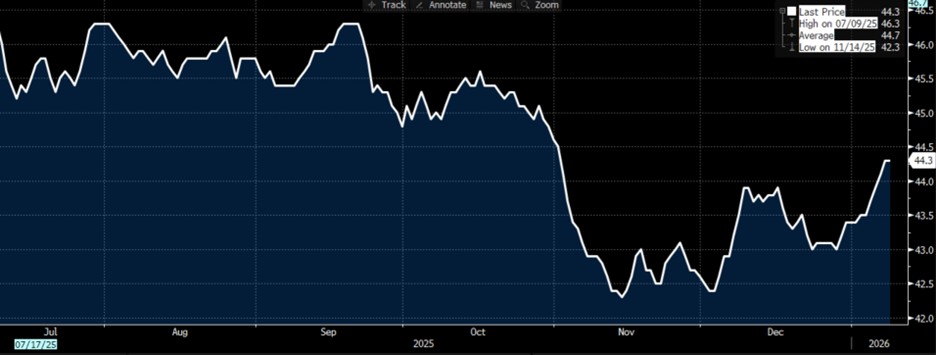
These geopolitical strategies carry substantial execution risk. Even a low probability of military confrontation, policy miscalculation, or escalation error justifies a higher geopolitical risk premium across asset classes.
Rising geopolitical tensions are increasingly reflected in global defence spending. In the United States, President Trump has proposed a defence budget of $1.5 trillion for 2027, representing an increase of approximately 60 percent compared with approved 2026 levels.
Despite the escalation in geopolitical risk, financial markets show limited signs of stress. The S&P 500 continues to trade at all-time highs, the US dollar is grinding higher, Brent crude has stabilised and rebounded from the $60 level, and 6- and 12-month S&P500 and FX implied volatility remains sanguine and below twelve-month averages.
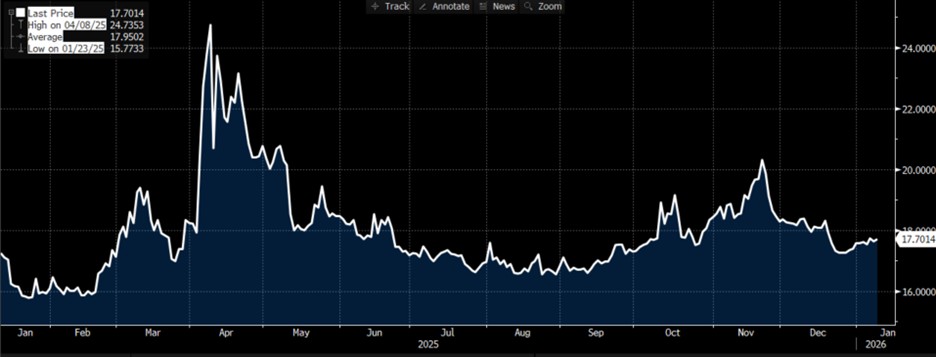
One interpretation is that recent US actions have been deliberately calibrated to avoid destabilising financial markets. Under this framework, market stability and political approval act as constraints on how far geopolitical escalation can extend.
Beyond recent headlines, several ongoing geopolitical risks remain critical for investors in 2026. These include tensions between China and Taiwan, the war between Russia and Ukraine, instability involving Iran and Israel, internal unrest in Iran, and rising domestic tensions in the United States linked to immigration policy and civil unrest following the fatal shooting of Renee Good in Minneapolis.
Markets have historically struggled to price geopolitical risk in advance. Investors tend to prefer reacting once outcomes become clear rather than positioning for uncertain scenarios. The prevailing assumption appears to be that tensions will rise rhetorically without escalating into worst-case outcomes.
Markets are dynamic, and shifts in geopolitical risk are rarely linear. When perceptions change, repricing tends to be fast, disorderly, and cross-asset in nature. There is growing concern that markets are underestimating the risk of a more fractured US–NATO relationship or a policy miscalculation related to Greenland with broader strategic consequences.
While the full impact of these developments remains uncertain, one conclusion is already clear. Geopolitical risk in 2026 has increased materially, even before considering other major macroeconomic risks such as monetary policy, debt sustainability, and global growth uncertainty.
Disclaimer:
The material provided here has not been prepared in accordance with legal requirements designed to promote the independence of investment research and as such is considered to be a marketing communication. Whilst it is not subject to any prohibition on dealing ahead of the dissemination of investment research we will not seek to take any advantage before providing it to our clients. Pepperstone doesn't represent that the material provided here is accurate, current or complete, and therefore shouldn't be relied upon as such. The information, whether from a third party or not, isn't to be considered as a recommendation; or an offer to buy or sell; or the solicitation of an offer to buy or sell any security, financial product or instrument; or to participate in any particular trading strategy. It does not take into account readers' financial situation or investment objectives. We advise any readers of this content to seek their own advice. Without the approval of Pepperstone, reproduction or redistribution of this information isn't permitted.
Publication date: