AI Optimism and Falling Oil Drive Wall Street Higher

Key Takeaways:
*Wall Street remains supported by falling oil prices and easing geopolitical fears
*Nasdaq continues outperforming as AI and semiconductor momentum stay strong
*Lower Treasury yields are improving sentiment toward growth and technology stocks
*Wall Street remains supported by falling oil prices and easing geopolitical fears
*Nasdaq continues outperforming as AI and semiconductor momentum stay strong
*Lower Treasury yields are improving sentiment toward growth and technology stocks
Market Summary:
Wall Street extended its broader risk-on recovery as falling oil prices, easing geopolitical fears, and ongoing AI-driven optimism continued supporting investor sentiment. Major U.S. indices recently closed higher, with the Dow Jones Industrial Average climbing toward the 50,580 region, the S&P 500 remaining near record highs around 7,473, and the Nasdaq continuing to outperform near 26,344 as technology and semiconductor stocks maintained leadership across global markets.
Wall Street extended its broader risk-on recovery as falling oil prices, easing geopolitical fears, and ongoing AI-driven optimism continued supporting investor sentiment. Major U.S. indices recently closed higher, with the Dow Jones Industrial Average climbing toward the 50,580 region, the S&P 500 remaining near record highs around 7,473, and the Nasdaq continuing to outperform near 26,344 as technology and semiconductor stocks maintained leadership across global markets.
The primary driver behind the latest rally has been the sharp decline in oil prices following optimism surrounding potential U.S.–Iran negotiations. Lower energy prices are helping reduce inflation expectations, ease pressure on Treasury yields, and improve confidence that the Federal Reserve may avoid further aggressive tightening. This has created a more supportive environment for equities, particularly growth-oriented sectors that are highly sensitive to interest rate expectations.
The Nasdaq continues leading the broader market rally as investors remain heavily positioned in AI-related sectors, cloud computing, semiconductors, and mega-cap technology companies. Ongoing enthusiasm surrounding artificial intelligence infrastructure spending has continued attracting strong capital inflows into tech, helping offset broader macroeconomic concerns. Lower Treasury yields following the oil pullback have further improved sentiment toward high-valuation growth stocks, allowing the Nasdaq to maintain relative strength compared to more cyclical indices.
Meanwhile, the S&P 500 has benefited from a broader improvement in risk appetite as easing inflation fears support both technology and consumer-related sectors. Investors increasingly believe that if oil prices continue trending lower, the overall macro environment could stabilize further, helping corporate earnings remain resilient despite slowing global growth conditions. The index has therefore remained supported by expectations that moderating inflation could eventually provide the Federal Reserve with more flexibility later in the year.
The Dow Jones Industrial Average has also participated in the rally but remains relatively more sensitive to fluctuations in oil prices and economic growth expectations due to its heavier exposure toward industrials, financials, and cyclical companies. Falling energy prices are helping ease concerns surrounding transportation costs, manufacturing pressures, and consumer demand, all of which have supported recent Dow strength. However, analysts continue warning that any renewed surge in crude oil could disproportionately pressure the Dow compared to the Nasdaq.
Despite the improving market sentiment, several risks continue limiting the strength of the rally. Thin liquidity conditions following the U.S. holiday period have amplified intraday volatility, while upcoming economic data releases particularly U.S. Consumer Confidence, Core PCE inflation, GDP revisions, jobless claims, and durable goods orders could significantly impact Federal Reserve expectations and broader equity direction. Markets are also closely monitoring upcoming earnings from major companies including Salesforce, Dell, and Costco, which may provide further insight into consumer resilience and corporate spending trends.
Overall, markets currently remain in a “risk-on but cautious” environment. Falling oil prices and de-escalation hopes continue supporting equities, particularly technology and AI-driven sectors. However, geopolitical uncertainty remains unresolved, and investors understand that any deterioration in U.S.–Iran negotiations or renewed energy disruptions could rapidly reverse sentiment. For now, lower oil prices, softer yields, and persistent AI optimism remain the key pillars supporting Wall Street’s bullish momentum.
Technical Analysis
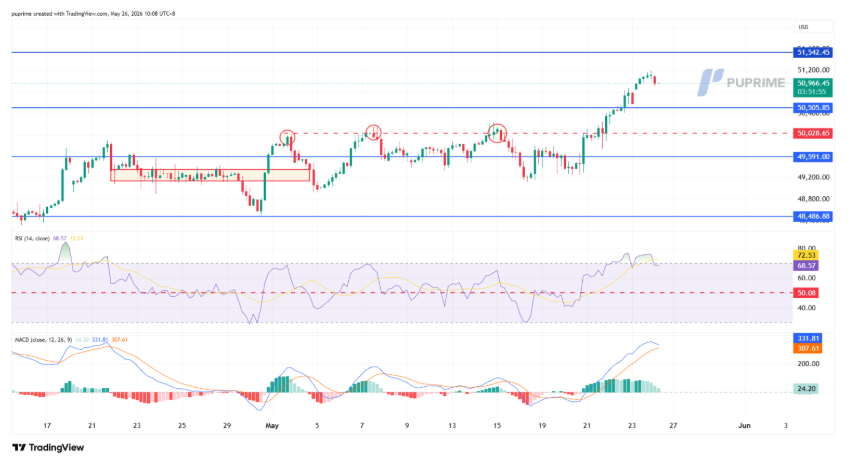
Dow Jones, H4:
The Dow Jones Industrial Average continues to trade within a constructive bullish structure with price recently breaking above the key 50,030 resistance zone after multiple prior rejection attempts. Earlier rallies into this region were repeatedly capped by selling pressure, as highlighted by the series of failed breakouts near the dashed resistance line. However, the latest advance showed stronger follow-through momentum, allowing the index to decisively clear the barrier and establish a fresh short-term breakout.
The breakout above 50,030 signals improving market confidence and reinforces the broader upward trajectory that has been developing since mid-May. Price has now accelerated toward the next resistance region near 51,540, while maintaining a sequence of higher highs and higher lows. Nevertheless, the sharp impulsive rally has created a stretched near-term structure, increasing the likelihood of a temporary consolidation or technical retracement as the market absorbs recent gains.
Momentum indicators continue to support the bullish outlook, although signs of short-term exhaustion are beginning to emerge. RSI has climbed toward overbought territory above the 68 level, reflecting strong buying momentum but also suggesting that upside conditions are becoming increasingly extended. Meanwhile, MACD remains firmly in positive territory with an expanding bullish structure, though the histogram has started to stabilize slightly, indicating that momentum may be moderating after the aggressive breakout phase.
Overall, while short-term consolidation risks are increasing following the recent surge, the broader technical outlook remains constructive as long as the index continues to hold above key breakout support levels.
Resistance level: 51,540.00, 51,615.00
Support level: 50,505.00, 50,030.00
Publication date: