
Sterling under strain as bond markets hit historic levels

Sterling faces renewed pressure as bond market swings, fiscal uncertainty, and political shifts test investor confidence. Traders are watching to see whether the pound can steady or slide further.
Pound hit by debt concerns
The British pound dropped more than 1% on Tuesday, sliding to $1.3422, as a sharp selloff in UK government bonds pushed 30-year gilt yields to their highest level since 1998.
The British pound dropped more than 1% on Tuesday, sliding to $1.3422, as a sharp selloff in UK government bonds pushed 30-year gilt yields to their highest level since 1998.
The move has reignited market concerns over the UK’s fiscal outlook and its ability to keep public debt under control.
While the downturn in gilts mirrored the broader global bond market repricing, sterling’s sharpest one-day fall since June has underscored the UK’s fragility.
Chancellor Rachel Reeves is expected to announce tax hikes in the autumn budget in a bid to meet fiscal rules, a move that could weigh on economic growth.
At the same time, Prime Minister Keir Starmer reshuffled his cabinet this week in preparation for what is expected to be a challenging close to the year.
Rabobank strategist Jane Foley noted that although revised Bank of England expectations supported sterling last month, fiscal headwinds tied to the autumn budget may continue to limit gains.
The UK is not alone in facing scrutiny. In France, 30-year bond yields surged to their highest level in over 16 years, with Prime Minister François Bayrou working to prevent a potential government collapse.
Technical analysis
Since touching February’s low near 1.2250, GBP/USD has maintained an upward trajectory, climbing steadily to a July peak of 1.3788 before retreating.
Since touching February’s low near 1.2250, GBP/USD has maintained an upward trajectory, climbing steadily to a July peak of 1.3788 before retreating.
The pair is now trading around 1.3422, still holding above the key 1.3300 support zone.
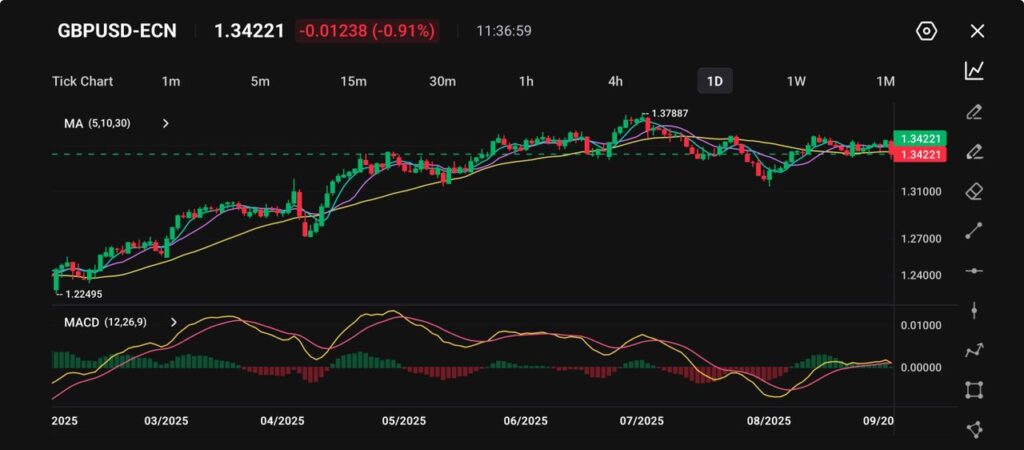
Picture: GBPUSD-ECN trades at 1.34221, down 0.91% from its recent high as it shown on the VT Markets app.
Short-term moving averages (5, 10, and 30) are levelling off, signalling a consolidation phase.
Meanwhile, the MACD has eased back to hover near the zero line, reflecting a loss of momentum compared with earlier in the year.
Publication date: