
Oil prices dip on speculation of higher OPEC+ output

Oil markets remain caught between supply uncertainty and demand signals, leaving traders on alert for the next move. Speculation around OPEC+ production policy, upcoming US stockpile data, and shifting global consumption trends are all shaping sentiment, keeping volatility alive and market direction unclear.
Traders on edge ahead of OPEC+ talks
Oil prices moved lower in Thursday’s early trading session as market participants positioned cautiously before the upcoming OPEC+ policy meeting.
Oil prices moved lower in Thursday’s early trading session as market participants positioned cautiously before the upcoming OPEC+ policy meeting.
West Texas Intermediate (WTI) slipped 1.0% to $63.32 per barrel, while Brent crude dropped 0.9% to $66.96, wiping out the previous day’s gains.
The pullback followed a Reuters report indicating that the group could weigh further production increases. Even without an official decision, the possibility of more barrels hitting the market unsettled traders.
Uncertainty remains high, particularly with the US Energy Information Administration (EIA) due to release its weekly stockpile data later today. Investors are keen to see whether demand from the world’s top oil consumer can offset the renewed supply-side risk.
Technical analysis
Crude oil (CL-OIL) is trading at $63.26, down 0.75% on the session, and consolidating after a volatile year. In April 2025, prices dipped as low as $55.11 before surging to $77.90 in July.
Crude oil (CL-OIL) is trading at $63.26, down 0.75% on the session, and consolidating after a volatile year. In April 2025, prices dipped as low as $55.11 before surging to $77.90 in July.
Since then, the market has traded in a broad range, with the 30-day moving average flattening and shorter-term averages (5 and 10) struggling to maintain upward momentum – signalling hesitation.
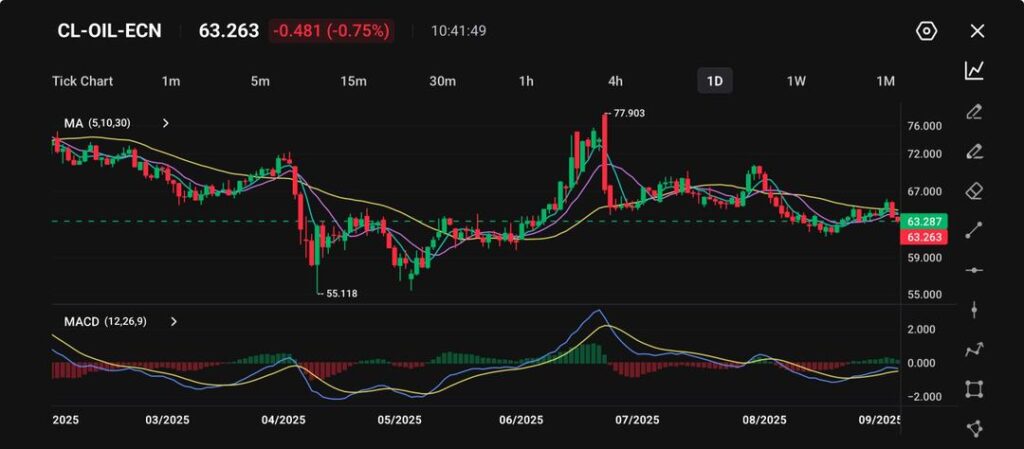
Picture: CL-OIL-ECN trades at 63.263, down 0.75% from its recent level as shown on the VT Markets app.
The MACD shows a mild bullish crossover but remains close to neutral, pointing to limited strength. Key support is placed at $60, with a deeper cushion at $55, while resistance levels stand at $67 and $72.
A sustained breakout above $67 could unlock fresh bullish momentum, whereas a decline below $60 would increase the risk of revisiting the yearly low.
In the short run, prices are expected to remain range-bound, with traders monitoring OPEC+ supply decisions, US inventory data, and broader demand recovery trends.
Publication date: