
Week ahead: US Jobs data is in focus

The week ahead welcomes a slew of key US employment metrics, which may further increase the odds of additional cuts from the US Federal Reserve (Fed) this year. This includes May JOLTS job openings, June ADP employment change (Automatic Data Processing), weekly jobless filings for the week ending 28 June, and, of course, the June jobs report, which will be released on Thursday due to US markets closing in observance of Independence Day.
US jobs data in the spotlight
The June US payrolls report is expected to show the economy added 110,000 new jobs, down from 135,000 in May – the estimate range is currently between a high of 140,000 and a low of 75,000. However, the unofficial, ‘whisper’ number for the month of June is around 100,000 jobs added; therefore, risk is skewed to the downside here.
The June US payrolls report is expected to show the economy added 110,000 new jobs, down from 135,000 in May – the estimate range is currently between a high of 140,000 and a low of 75,000. However, the unofficial, ‘whisper’ number for the month of June is around 100,000 jobs added; therefore, risk is skewed to the downside here.
Unemployment is anticipated to tick higher to 4.3% from 4.2% (note that the Fed’s latest projection by the end of 2025 is 4.5%), while wage growth is projected to remain unchanged at 3.9% year-on-year (YY), and ease slightly to 0.3% from 0.4% month-on-month (MM).
While still not ‘falling off a cliff’, the US jobs market is evidently cooling, but it is not soft enough for the Fed to release the brakes and ease policy at this point. However, should US employment come in lower than expected this week, we can expect markets to price in further Fed easing, I believe, which will likely fuel downside in the US dollar (USD).
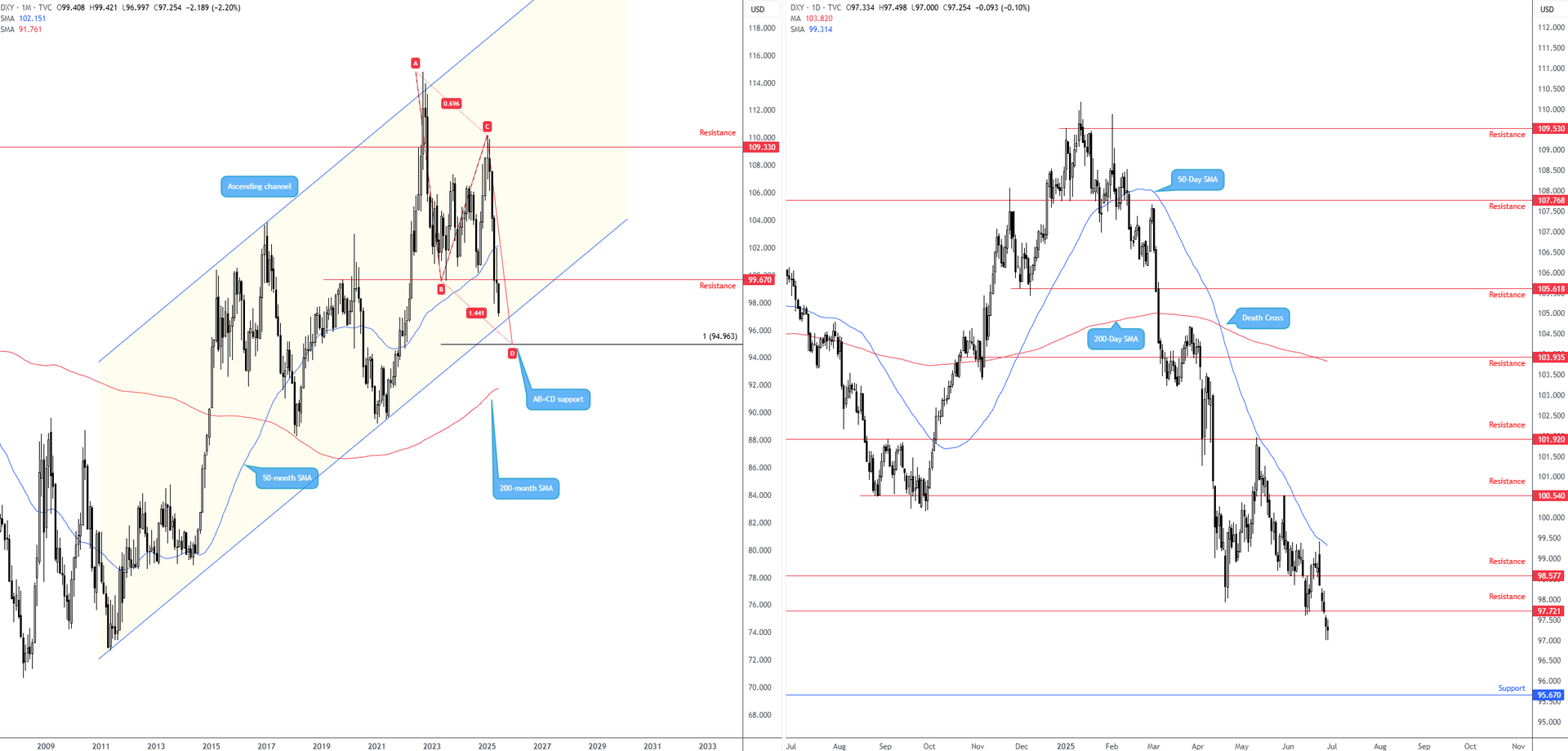
The Greenback concluded the week at multi-year lows, down 1.5%, with month-to-date losses on track to register 2.2%. As you can see from the technical charts below, the USD Index made short work of support from 99.67 on the monthly scale (marked resistance) and demonstrates scope for further underperformance towards channel support, extended from the low of 72.97, followed closely by an AB=CD support at 94.96. Adding to this bearish vibe, support was recently consumed on the daily scale at 97.72 (marked resistance), potentially paving the way for further downside to as far south as support from 95.67. This level resides near the monthly channel support and the AB=CD support. Therefore, 97.72 will be a level I will be monitoring closely this week.
You will recall that alongside last week’s geopolitical developments in the Middle East, the spotlight was also on the Fed Chair Jerome Powell’s two-day testimony before the House Financial Services Committee and the Senate Banking Committee. Much to the chagrin of US President Donald Trump, who has repeatedly called for lower rates, Powell largely stuck to the script, underscoring a ‘wait-and-see’ stance based on the economy’s strength and the need for more clarity on the impact of Trump’s economic policies.
According to The Wall Street Journal, Trump is expected to announce Powell’s successor as early as September (The Fed Chair will step down in May 2026), with candidates reportedly in the running including US Treasury Secretary Scott Bessent, former Fed Governor Kevin Warsh, and Fed Governor Christopher Waller. Despite this speculation, I think it is clear that Trump will select a Chair that aligns with his policy agenda, hence the dovish reaction seen in the markets following this announcement.
The announcement prompted further softness in the USD as investors ramped up rate cut bets and forecast 65 basis points (bps) of easing for the year: nearly three rate cuts. I do not see three rate reductions happening unless, of course, there is a deterioration in the jobs data. Assuming the Fed remains on hold at the end of July, three rate cuts this year would mean consecutive 25-bp rate cuts at each subsequent meeting in September, October, and November.
Additionally, this week, we have the June US ISM (Institute for Supply Management) manufacturing and services PMIs (Purchasing Managers’ Indexes) out. This follows last week’s June S&P Global flash PMIs, with both coming in higher than the market’s median expectation. We also observed price increases across both manufacturing and services. Consequently, if the ISM PMIs were to reflect a similar picture, this could offer some support to the USD and prompt a moderate hawkish repricing. This may also be more pronounced if the jobs data came in stronger than expected later in the week.
Notably, the Personal Income and Outlays report for May was released last Friday. PCE inflation data (Personal Consumption Expenditures) showed a slight uptick in the YY core measure to 2.7% from 2.5% in April (consensus: 2.6%), with the YY headline report also ticking higher to 2.3% from 2.1%, in line with market consensus. Personal income and spending declined, showing moderate tariff pass-through as consumers pulled back their spending where they could in motor vehicles and particularly in discretionary services like food and travel. So, from this report, what we have here is a situation of lower income and moderately higher prices in May, which follows CPI (Consumer Price Index) and PPI (Producer Price Index) inflation also ticking higher in May.
Additional risk events to have on the radar this week:
June Chinese manufacturing and services PMIs on Monday, with a slight uptick in the former to 49.6 expected (previous: 49.5), with the latter anticipated to remain unchanged at 50.3.
The European Central Bank’s (ECB) annual forum in Sintra, Portugal, will be one to keep an eye out for on Tuesday. Central bank speakers include Fed Chair Powell, ECB President Christine Lagarde, Bank of England Governor Andrew Bailey, and the Bank of Japan Kazuo Ueda.
The June HICP eurozone CPI inflation data will also be released on Tuesday, with the YY headline print expected to tick slightly higher to 2.0%, up from 1.9% in April, along with the core measure, which excludes food, energy, alcohol, and tobacco components, projected to remain unchanged at 2.3%.
June Swiss CPI inflation will be released on Thursday, and is forecast to have declined 0.1% YY, matching May’s print, with MM inflation expected at 0.0%, slightly lower than the 0.1% previous reading.
Charts created using TradingView
June Chinese manufacturing and services PMIs on Monday, with a slight uptick in the former to 49.6 expected (previous: 49.5), with the latter anticipated to remain unchanged at 50.3.
The European Central Bank’s (ECB) annual forum in Sintra, Portugal, will be one to keep an eye out for on Tuesday. Central bank speakers include Fed Chair Powell, ECB President Christine Lagarde, Bank of England Governor Andrew Bailey, and the Bank of Japan Kazuo Ueda.
The June HICP eurozone CPI inflation data will also be released on Tuesday, with the YY headline print expected to tick slightly higher to 2.0%, up from 1.9% in April, along with the core measure, which excludes food, energy, alcohol, and tobacco components, projected to remain unchanged at 2.3%.
June Swiss CPI inflation will be released on Thursday, and is forecast to have declined 0.1% YY, matching May’s print, with MM inflation expected at 0.0%, slightly lower than the 0.1% previous reading.
Charts created using TradingView
Written by FP Markets Chief Market Analyst Aaron Hill
Publication date: