
Forex market analysis: 15 May 2025

Oil prices are under pressure again as traders react to shifting global dynamics, from renewed nuclear talks with Iran to growing concerns about the health of major economies. After a brief period of optimism, market sentiment has turned cautious, with geopolitical risks and central bank signals now shaping the outlook. This shift has prompted a closer look at both the technical and fundamental landscape driving oil’s next move.
Oil retreats amid nuclear deal speculation and macro headwinds
Oil prices tumbled on Thursday, with West Texas Intermediate (WTI) crude shedding 2.13% to settle at USD 61.06 per barrel.
Oil prices tumbled on Thursday, with West Texas Intermediate (WTI) crude shedding 2.13% to settle at USD 61.06 per barrel.
The downturn was largely driven by renewed speculation over a potential nuclear agreement between the United States and Iran, which could pave the way for sanctions on Iranian oil exports to be eased—raising concerns over an increase in global supply.
This latest drop follows a brief rally sparked by a 90-day tariff truce between the US and China, which had initially lifted hopes for a demand recovery. However, that optimism has quickly faded.
According to IG’s Tony Sycamore, the pullback feels like a “hangover after a massive party,” with traders becoming more cautious as broader economic risks come back into focus.
Sentiment was further hit by President Donald Trump’s comments on the US federal budget deficit and growing concerns about the sustainability of the country’s economic expansion.
Meanwhile, the 10-year Treasury yield rose to a one-month high, heightening investor unease about rising borrowing costs and ballooning debt levels.
Equity markets also turned lower, amplifying the risk-off mood. Japan’s Nikkei slipped by 0.85%, and China’s CSI300 fell 0.63%.
European indices followed suit, while US futures pointed to a weaker open ahead of key retail sales figures and Walmart earnings—both considered indicators of consumer confidence and economic momentum.
Technical analysis: Oil under pressure, bearish trend intact
WTI crude continues to trade lower, with CL-OIL-ECN falling from USD 63.88 to a session low of USD 60.95 over the past two days—marking a decline of more than 4.5%.
WTI crude continues to trade lower, with CL-OIL-ECN falling from USD 63.88 to a session low of USD 60.95 over the past two days—marking a decline of more than 4.5%.
Technical indicators remain bearish, with prices now firmly below the 5-, 10-, and 30-period moving averages, signalling continued downward momentum.
Selling intensified after breaking below the key support level near USD 62.00, with only modest buying interest seen during minor rebound attempts.
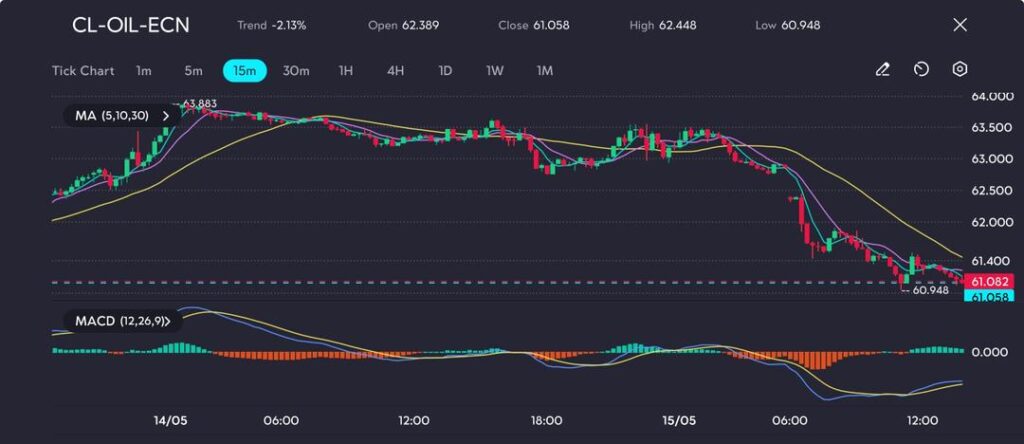
Oil tumbles to USD 60.95 as bearish momentum deepens, with short-term pressure persisting below USD 62 resistance, as seen on the VT Markets app.
The MACD indicator remains in negative territory, although histogram bars are showing signs of stabilisation, suggesting the downward momentum may be easing slightly.
However, without a decisive bullish crossover or a reclaim of the USD 61.50–62.00 zone, further losses remain likely. The path of least resistance still points lower in the near term.
Short-term outlook: Volatility expected as traders eye geopolitical developments
Crude oil is expected to remain volatile as markets digest ongoing geopolitical news and commentary from central banks.
Crude oil is expected to remain volatile as markets digest ongoing geopolitical news and commentary from central banks.
A confirmed breakthrough in US–Iran negotiations could put further pressure on prices, potentially testing the USD 60.00 support zone.
Conversely, if talks stall or the Federal Reserve signals a more dovish stance, a rebound toward the USD 62.50–63.00 range is possible.
Today’s US retail sales data and remarks from Fed Chair Jerome Powell are likely to play a crucial role in shaping the short-term trajectory of oil prices.
Publication date: