
US payrolls surprise to the downside following Fed holding ground; BoE on course for another quarter

Before we dive into the key event of the week, the downside surprise in the July US payrolls data deserves note. The release offered market participants a clear-cut opportunity to trade out of, which, let’s face it, has been few and far between of late, given global uncertainty surrounding US President Donald Trump’s tariffs.
The US dollar (USD) and, in particular, the front end of the yield curve, tanked following the release of the jobs numbers. The 2-year US Treasury yield immediately fell 14 basis points (bps), with investors all but fully pricing in a 25-bp rate cut in September and 64 bps of easing for the year-end. From this, we can see that investors are nearly pricing in three rate reductions from the US Federal Reserve (Fed) this year, meaning we could see rate cuts in September, October, and December. Stocks also finished the week lower, with the S&P 500 and the Nasdaq chalking up weekly bearish engulfing candles and snapping a lengthy winning streak.
Payrolls rose by 73,000, down from 147,000 in June, and from the 110,000 gain forecasted. A look at previous data will show you that this is the first softer-than-expected payroll print since March. The chunky downward revisions were key, and essentially chalked up a more pessimistic picture. The report noted that revisions were bigger than usual for May (revised lower by 125,000 from 144,000 to 19,000) and June (revised down by 133,000, from 147,000 to 14,000). This also brought the 3-month average to just 35,000 in total non-farm payrolls, reflecting a considerably slower pace of hiring in the US.
Digging into the data a little more, you will note that ‘Healthcare and social assistance’ saw a gain in July, and it appears to be the only industry supporting the jobs market right now. Without these gains, we would have seen the payrolls fall into negative territory.
The unemployment rate also ticked higher to 4.2% up from 4.1%, as expected, and wages rose both on a month-on-month and year-on-year basis to 0.3% (up from 0.2%) and 3.9% (up from 3.8% [revised from 3.7%]). The labour force participation rate dropped to 62.2% (down from 62.3%), marking the third consecutive monthly drop, suggesting that people are discouraged from seeking work or that they are leaving the workforce.
The weaker jobs data have certainly called into question the Fed’s wait-and-see stance. We have one more jobs report and two inflation reports ahead of the September meeting to contend with, which will be important, but markets are now largely looking to September for a 25 bp rate cut.
As far as I see things here, should jobs data continue to weaken, this could prompt the Fed to ease policy faster to offer support, and further weigh on the USD. July was positive for the US dollar, with the US Dollar Index adding 3.0% and snapping multi-month declines. However, given Friday’s sell-off, nearly half of July’s gains were wiped out.
BoE poised to cut rates
One of the highlight events this week will be the Bank of England (BoE) on Thursday at 11:00 GMT. The rate decision will be released alongside the rate statement and updated economic forecasts.
One of the highlight events this week will be the Bank of England (BoE) on Thursday at 11:00 GMT. The rate decision will be released alongside the rate statement and updated economic forecasts.
Although the central bank is expected to reduce the Bank Rate by 25 bps to 4.00% from 4.25%, the decision is likely to be far from unanimous. Consequently, the MPC (Monetary Policy Committee) vote split could be interesting to monitor. A 7-2 split in favour of cutting by 25 bps is currently forecasted according to LSEG data, though a three-way split is possible, with some desks suggesting two votes may be for a larger 50-bp reduction. You will recall that the MPC voted 6-3 in favour of holding things steady in June, and was considered to be a slightly ‘dovish hold’. Two of the three members – Swati Dhingra and Alan Taylor – also voted for a rate reduction at May’s meeting.
I am not expecting much from forward guidance this week, and anticipate the BoE will reiterate its ‘careful and gradual’ approach, given uncertainty remaining elevated. What they will very unlikely do is signal an acceleration in its pace of easing; if they do, expect GBP weakness. All in all, I imagine guidance to strike a balance between acknowledging recent inflation stickiness and maintaining the gradual, quarterly easing trajectory.
For the updated economic forecasts, we could see near-term inflation expectations revised upwards. However, ultimately, the BoE are likely to frame this as temporary inflation. In terms of the labour market, we can expect the central bank to highlight continued labour market slack and wage growth undershooting its 5.2% estimate (in the three months to June). With this being said, while this will be monitored, I feel most of the market will be watching the vote split and any language surrounding this. A more dovish split is likely to weigh on the GBP and Gilt yields, while a more hawkish/cautious vote split could underpin a bid in said markets.
Money markets are currently pricing in 21 bps worth of cuts for this week’s meeting, 46 bps of easing for the year-end, and one more rate cut following this, potentially at the February 2026 meeting for an overall terminal rate of 3.50%.
Data has been up and down since the last meeting
While a recession has been avoided in the first half of 2025, things are far from rosy, posting back-to-back monthly GDP contractions (Gross Domestic Product) in April and May. This, as you can imagine, is a blow for the Labour Party, which pledged economic growth as a key priority. You may recall that the government recently announced a welfare reform U-turn on welfare cuts, leaving UK Chancellor Rachel Reeves with little fiscal headroom. She appears to be between a rock and a hard place at the moment, juggling between upsetting the British public and raising taxes, or upsetting the bond market by borrowing more. Both of which are something the government has said it would not do. Having lost approximately £5 billion in planned welfare savings while facing commitments not to raise taxes or increase borrowing significantly, the autumn budget – expected in late October or early November – will likely require breaking one of these pledges.
While a recession has been avoided in the first half of 2025, things are far from rosy, posting back-to-back monthly GDP contractions (Gross Domestic Product) in April and May. This, as you can imagine, is a blow for the Labour Party, which pledged economic growth as a key priority. You may recall that the government recently announced a welfare reform U-turn on welfare cuts, leaving UK Chancellor Rachel Reeves with little fiscal headroom. She appears to be between a rock and a hard place at the moment, juggling between upsetting the British public and raising taxes, or upsetting the bond market by borrowing more. Both of which are something the government has said it would not do. Having lost approximately £5 billion in planned welfare savings while facing commitments not to raise taxes or increase borrowing significantly, the autumn budget – expected in late October or early November – will likely require breaking one of these pledges.
Not only is UK growth lacklustre, but the BoE has to contend with lingering price pressures, which I believe will prompt policymakers to err on the side of caution at this meeting, hence offering anything concrete in terms of guidance. The June UK CPI inflation data (Consumer Price Index) showed price pressures rose at the headline and core levels, rising 3.6% (up from 3.4%), its highest rate since the beginning of 2024, and 3.7% (up from 3.5%), respectively. It is important to note that services inflation remained at 4.7% in June, defying estimates that it would ease off.
In terms of the jobs market, data shows the labour market continues to loosen, which I feel helps provide reasoning for a cut this week. Unemployment ticked to its highest level since July 2021 at 4.7% in the three months to May 2025. Wages continue to trend south, and payrolled employment dropped by 41,000 in June, marking the steepest deceleration since late 2020 and the fifth consecutive month of declines. Job vacancies also continue to exhibit a trend lower, and wage growth, albeit still considered elevated, is trending south, recently reaching 5.0% in the three months to May, and touching a fresh cycle low for pay excluding bonuses.
Technical picture for the GBP
The British pound (GBP) settled lower in July, down 3.9% versus the USD, and lower by 0.7% versus the euro (EUR). COT positioning data (Commitment of Traders) indicates the GBP is currently stretched to the downside. Given the thin data for the UK ahead of the meeting, we are unlikely to see significant changes in BoE rate pricing before this week’s meeting.
The British pound (GBP) settled lower in July, down 3.9% versus the USD, and lower by 0.7% versus the euro (EUR). COT positioning data (Commitment of Traders) indicates the GBP is currently stretched to the downside. Given the thin data for the UK ahead of the meeting, we are unlikely to see significant changes in BoE rate pricing before this week’s meeting.
Versus the USD, we do not need a trend indicator to tell us there has been an upside bias in play since late 2022, posting a series of higher highs/lows on the monthly scale. Nevertheless, in the longer term, this market has been trending lower since 2008; therefore, the current uptrend from 2022 lows is still considered a pullback until breaching US$1.4250. Meanwhile, given the fractal nature of price action, daily price ended Friday testing an AB=CD bullish pattern at US$1.3164, formed by way of a 100% projection ratio that is complemented by a 38.2% Fibonacci retracement ratio and a 200% extension ratio. You will find AB=CD longs tend to target the 38.2% and 61.8% Fibonacci retracement ratios of legs A-D, which in this case are US$1.3390 and US$1.3543, respectively. Therefore, we could see the GBP push higher in the short-term to at least around the US$1.34 handle.
GBP longs also make sense from a central bank divergence perspective. The Fed is now expected to ease more aggressively after being on hold over the past five meetings, and the BoE is still forecast to maintain its careful and gradual approach.
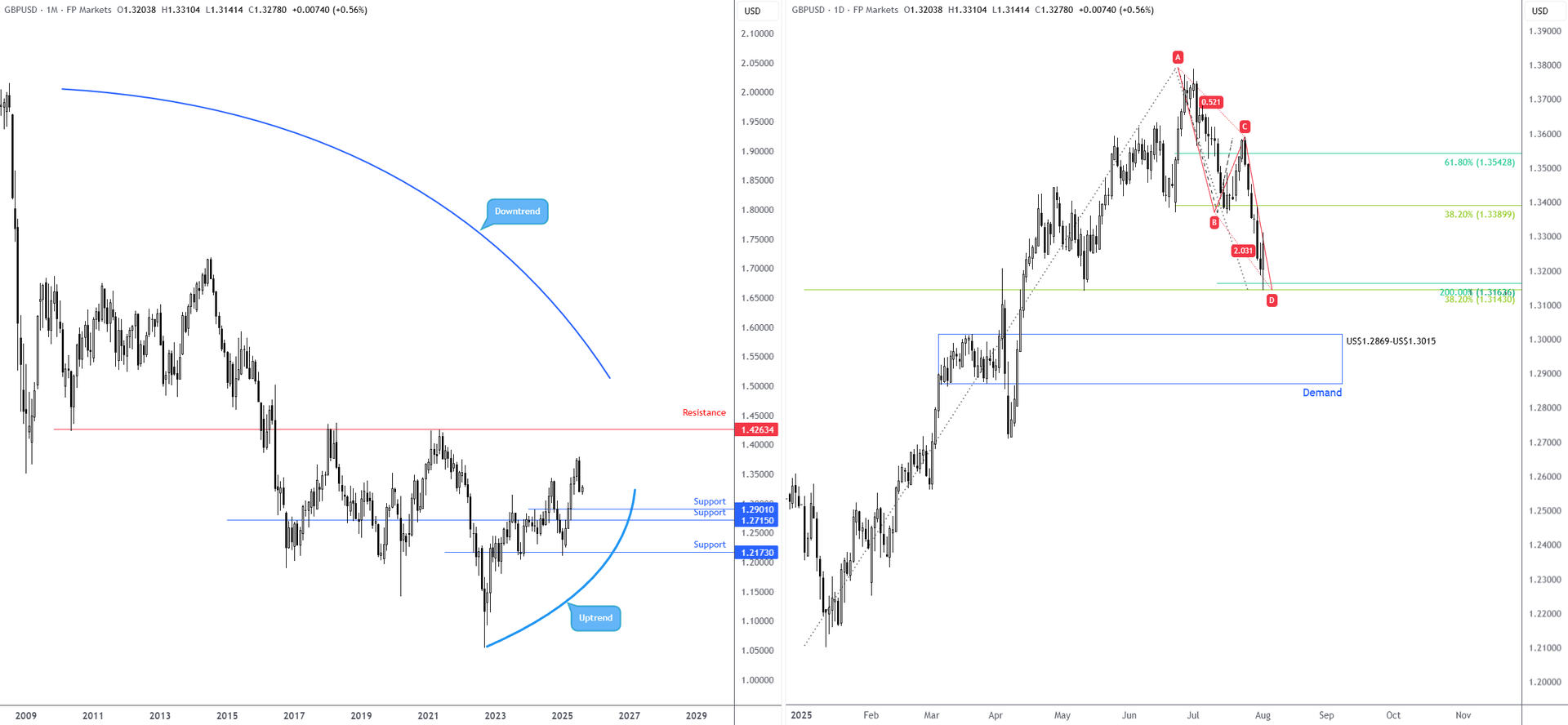
Charts created using Trading View
Written by FP Markets Chief Market Analyst Aaron Hill
Publication date: