
Week ahead: Tariffs and US Data in the spotlight

Where we were
It was a holiday-shortened week for many in the markets, as most financial centres closed their doors in observance of the Easter weekend. Despite this, and while everything could change with a social media post, there was a noticeable softening in the stance on trade between the US and China. As things stand, the US maintains a staggering 145% levy on Chinese imports, while China continues to impose tariffs of 125% on most US goods, effectively declaring a trade embargo between the two sides. During the International Monetary Fund and World Bank annual meetings last week, US Treasury Secretary Scott Bessent remarked that the US and China recognise that the current tariffs are unsustainable. He also indicated that a de-escalation of these tariffs would occur ‘in the very near future’, which helped ease concerns in the markets. Additionally, US President Donald Trump stated that tariffs on China would ‘significantly’ decrease once the two countries reach a negotiated agreement.
It was a holiday-shortened week for many in the markets, as most financial centres closed their doors in observance of the Easter weekend. Despite this, and while everything could change with a social media post, there was a noticeable softening in the stance on trade between the US and China. As things stand, the US maintains a staggering 145% levy on Chinese imports, while China continues to impose tariffs of 125% on most US goods, effectively declaring a trade embargo between the two sides. During the International Monetary Fund and World Bank annual meetings last week, US Treasury Secretary Scott Bessent remarked that the US and China recognise that the current tariffs are unsustainable. He also indicated that a de-escalation of these tariffs would occur ‘in the very near future’, which helped ease concerns in the markets. Additionally, US President Donald Trump stated that tariffs on China would ‘significantly’ decrease once the two countries reach a negotiated agreement.
At the tail end of last week, Trump claimed that Chinese President Xi Jinping had called him to discuss ‘business’ and that ‘200’ trade deals were weeks from being finalised. However, Chinese officials denied that any talks are taking place, and in typical ‘Trump fashion’, who, let’s be frank, works to his playbook, failed to provide specifics on the telephone conversation.
As I noted in a previous post, the on-off tariffs since ‘Liberation Day’ on 2 April, along with the latest developments, have – if you can believe it – all occurred in a month. While the atmosphere remains uncertain and, as I mentioned above, could change with a social media comment, it is worth noting that trade deals are usually not finalised in a few weeks; negotiations will likely take months rather than weeks.
Where we are
While trade news developments will continue to shape market sentiment, the economic calendar includes several tier-1 events this week. The US, in particular, features an eventful docket, including jobs, inflation, and growth data.
While trade news developments will continue to shape market sentiment, the economic calendar includes several tier-1 events this week. The US, in particular, features an eventful docket, including jobs, inflation, and growth data.
The non-farm payrolls (NFP) report will be a key event to monitor on Friday. The US economy is expected to have added 120,000 new jobs in April, according to the latest median estimate from LSEG data, cooling from 228,000 in March; the estimate range is currently between 150,000 and 50,000. The unemployment rate is forecast to remain at 4.2%, with month-on-month (MM) wage growth anticipated to have risen by 0.3% (matching March’s print) and year-on-year (YY) wages expected to have ticked higher to 3.9% from 3.8% in March.
Heading into the event, it is worth noting that unemployment claims have been stable around the 220k mark, with the 4-week moving average slightly moderating from the previous week, and continuing claims also taking a minor hit. Service sector jobs rose modestly in April, and manufacturing jobs were cut for the first time since late last year. Chief Business Economist at S&P Global Market Intelligence, Chris Williamson, commented: ‘The early flash PMI data for April point to a marked slowing of business activity growth at the start of the second quarter, accompanied by a slump in optimism about the outlook. At the same time, price pressures intensified, creating a headache for a central bank which is coming under increasing pressure to shore up a weakening economy just as inflation looks set to rise’.
Overall, I am not expecting tariffs to have much of an impact on jobs at this time.
Wednesday will be a busy one. GDP (Gross Domestic Product) data will be the first estimate for real GDP for Q1 25, with the economy estimated to have cooled to an annualised rate of 0.4%, down from 2.4% in Q4 24. Per the Atlanta GDPNow model, the latest estimate for Q1 25 growth (24 April) is -2.5% (annualised). According to the ‘alternative model forecast’, which adjusts for imports and exports of Gold, it is running at -0.4%. The first estimate of US GDP data will likely show some of the anticipated impact of trade tariffs in Q1, hence, the marked slowdown forecasted. Wednesday also sees the latest PCE price index data (Personal Consumption Expenditures) – which the US Federal Reserve (Fed) uses to measure inflation – and economists expect price pressures to have cooled across the board in March. MM, headline (core) PCE inflation is expected to have cooled to 0.0% from 0.3% (0.1% from 0.4%), and YY headline (core) PCE inflation is anticipated to have eased to 2.2% from 2.5% (2.6% from 2.8%).
Rate cut unlikely next month
The Fed will likely maintain the overnight target rate at 4.25% – 4.50% in May, with about two basis points (bps) of easing priced in for a 25 bp cut. For the year, investors are still expecting around three rate cuts (84 bps priced in) – the first rate reduction is anticipated either in June or July. Before the Fed entered its blackout period on 20 April, Fed officials expressed caution and patience regarding policy easing amid tariff uncertainty, indicating that rate cuts were not on the agenda for May’s meeting.
The Fed will likely maintain the overnight target rate at 4.25% – 4.50% in May, with about two basis points (bps) of easing priced in for a 25 bp cut. For the year, investors are still expecting around three rate cuts (84 bps priced in) – the first rate reduction is anticipated either in June or July. Before the Fed entered its blackout period on 20 April, Fed officials expressed caution and patience regarding policy easing amid tariff uncertainty, indicating that rate cuts were not on the agenda for May’s meeting.
Fed Governor Christopher Waller also recently made the airwaves, stating that he believes tariffs will increase price pressures and lower employment and growth, but the effect on prices could be a one-time occurrence that will pass through. Waller also mentioned that responding to the impact of rising prices is challenging. Reflecting on the pandemic era, the Fed assumed that a spike in inflation was temporary, only to discover that it was not the case and found themselves behind the curve.
As I have mentioned in previous posts, given the impact of potential price increases from tariffs and the effect on growth, this continues to place the Fed between a rock and a hard place. It is no secret that the ‘soft’ data has shown signs of weakness, but it has yet to converge with the ‘hard’ data. Fed’s Waller noted that he does not expect to see much impact in hard numbers until the year’s second half, so the Fed will likely be on the sidelines until a clearer picture unfolds.
Market outlook
US Treasury yields concluded lower across the curve last week, while the US Dollar (USD) Index wrapped up in moderately positive territory, snapping a four-week losing streak. Safe haven FX was less in demand – both the Japanese yen (JPY) and the Swiss franc (CHF) ended the week negatively versus the USD – and Spot Gold (XAU/USD) also took a breather.
US Treasury yields concluded lower across the curve last week, while the US Dollar (USD) Index wrapped up in moderately positive territory, snapping a four-week losing streak. Safe haven FX was less in demand – both the Japanese yen (JPY) and the Swiss franc (CHF) ended the week negatively versus the USD – and Spot Gold (XAU/USD) also took a breather.
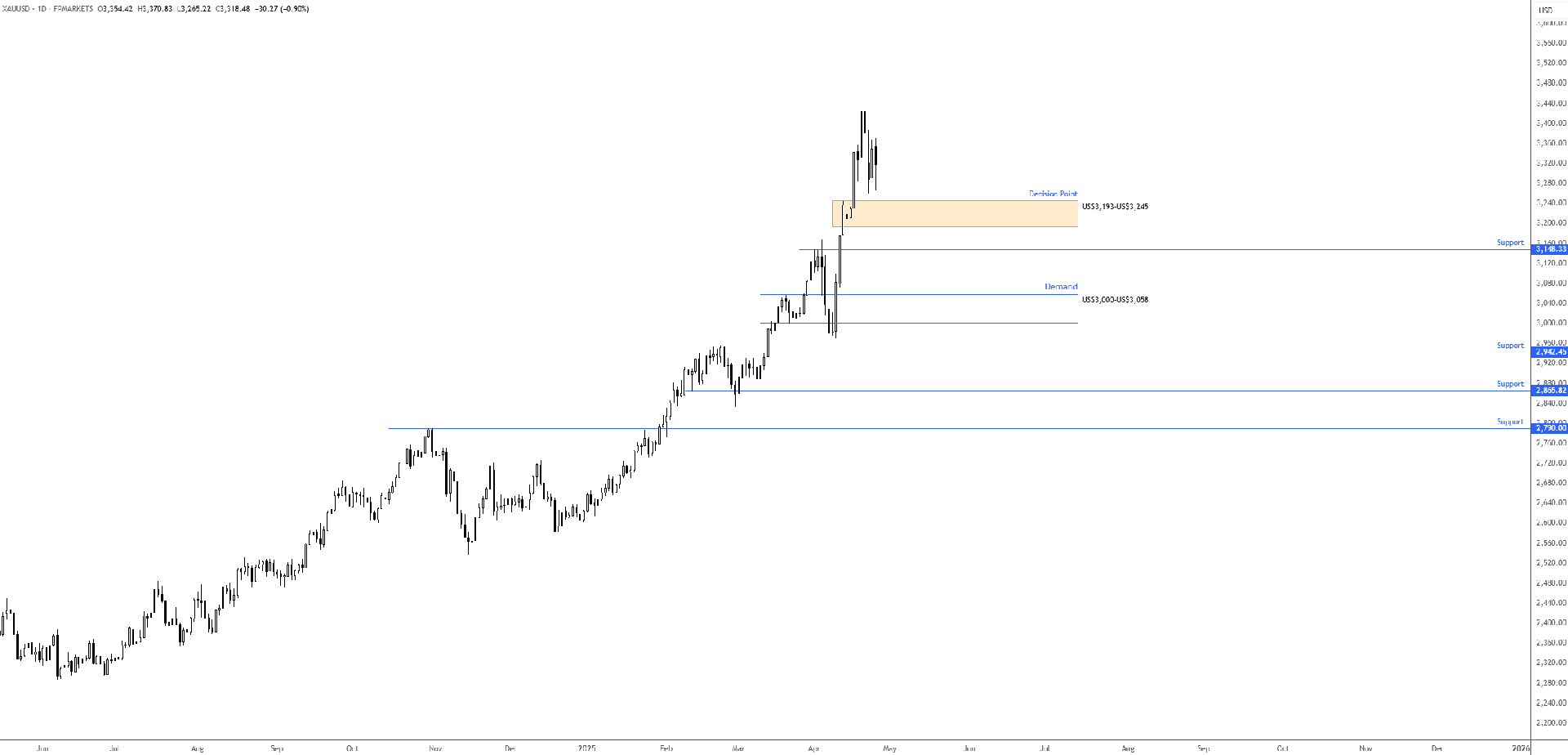
Gold has gained considerably in the last few years, and, as investors seek refuge in this go-to safe-haven asset amid trade concerns, it is up 26% this year after recently reaching all-time highs of US$3,500. Consequently, I believe many continue to view the yellow metal as a dip-buyers’ market. With price now within touching distance of a daily decision point area between US$3,193 and US$3,245, this could be a zone that trend followers closely monitor. However, it is worth pencilling in the possibility of a whipsaw through the aforementioned decision point base into support from US$3,148.
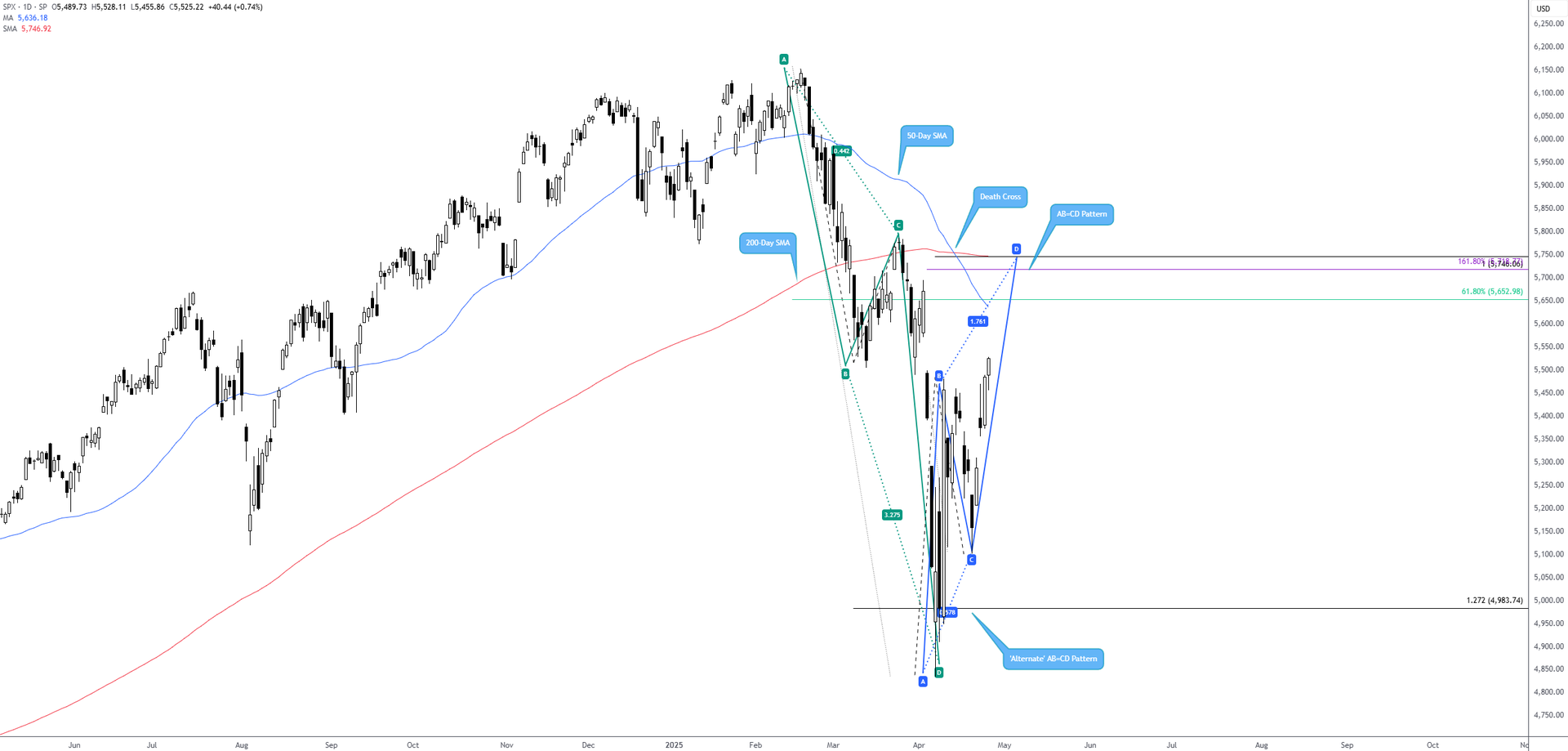
The S&P 500 has chalked up an interesting technical picture that I highlighted in the weekly Pattern Pulse edition. Following a low of 4,835 on 7 April – which touched gloves with an ‘alternate’ AB=CD support (1.272% Fibonacci projection ratio) at 4,983 – the S&P 500 index is on course to pencil in an ‘equal’ AB=CD resistance (100% projection ratio) at 5,746. Notably, the 5,746 level is accommodated by a 1.618% Fibonacci projection ratio at 5,718, as well as a nearby 61.8% Fibonacci retracement ratio at 5,652. Also of technical relevance, the market index has completed the dreaded ‘Death Cross’, which is the 50-day SMA at 5,645 crossing below the 200-day SMA at 5,746 (converges with the above-noted resistance zone), and suggests that a longer-term downtrend could be on the cards.
Charts created using TradingView
Written by FP Markets Chief Market Analyst Aaron Hill
Written by FP Markets Chief Market Analyst Aaron Hill
Publication date: