AI, Inflation & Volatility: What Traders Should Watch This Week

The market rally driven by semiconductor and AI-related stocks is no longer just a momentum story. It is now colliding directly with macroeconomic risks, inflation expectations, Federal Reserve policy uncertainty, and geopolitical tensions, creating one of the most important trading environments of 2026.
For traders, this week could determine whether the AI-fuelled rally continues pushing indices towards fresh highs, or whether markets finally experience a sharp correction after weeks of aggressive upside momentum.
Semiconductor Stocks Continue Leading the Market
Semiconductor companies remain the strongest force behind the recent rally in the S&P 500 and Nasdaq Composite. Investors continue rotating heavily into AI infrastructure plays as demand expands beyond GPUs into CPUs, memory chips, networking systems, and AI server infrastructure.
Semiconductor companies remain the strongest force behind the recent rally in the S&P 500 and Nasdaq Composite. Investors continue rotating heavily into AI infrastructure plays as demand expands beyond GPUs into CPUs, memory chips, networking systems, and AI server infrastructure.
The market is increasingly focused on the next stage of AI development: agentic AI.
Unlike traditional AI systems that mainly process requests, agentic AI performs autonomous tasks, makes decisions, and executes workflows with minimal human intervention. This transition is increasing demand for CPUs and inference-focused chips alongside traditional GPU infrastructure.
This explains why the semiconductor rally is broadening beyond Nvidia.
Stocks tied to AI servers, cloud infrastructure, data centres, memory chips, and enterprise AI integration are attracting increased institutional flows. AMD recently surged after forecasting stronger long-term CPU demand linked directly to agentic AI systems.
Current Market Conditions: Why Stocks Keep Rallying
Despite inflation concerns, geopolitical risks, and elevated oil prices, US equities continue climbing towards record highs. Several factors are supporting the bullish momentum:
- Strong corporate earnings
- Massive AI-related capital expenditure
- Expanding profit margins
- Rising earnings forecasts
- Expectations of future Fed rate cuts
- Ongoing institutional demand for tech and semiconductor stocks
- Strong corporate earnings
- Massive AI-related capital expenditure
- Expanding profit margins
- Rising earnings forecasts
- Expectations of future Fed rate cuts
- Ongoing institutional demand for tech and semiconductor stocks
Analysts note that hyperscaler companies including Microsoft, Amazon, Meta, Google, and Oracle are dramatically increasing AI infrastructure spending, with projected 2026 data-centre investments potentially exceeding $750 billion.
The result is a market environment where AI optimism is currently outweighing macroeconomic fears.
However, traders should not ignore an important warning sign:
Market breadth remains weak.
A relatively small group of mega-cap technology and semiconductor stocks continues doing most of the heavy lifting for the broader indices. This concentration increases vulnerability if sentiment suddenly shifts.
Why This Week Matters So Much
This week contains several major catalysts capable of creating significant volatility across equities, forex, bonds, commodities, and crypto markets.
This week contains several major catalysts capable of creating significant volatility across equities, forex, bonds, commodities, and crypto markets.
1. US CPI Inflation Data
The biggest event this week is the US Consumer Price Index (CPI) report.
The biggest event this week is the US Consumer Price Index (CPI) report.
Markets are watching closely to determine whether recent energy price increases are starting to spill into broader inflation categories. A hotter-than-expected inflation reading could reduce expectations for future Fed rate cuts and pressure risk assets.
For traders, inflation data could heavily impact:
- Nasdaq volatility
- Semiconductor stocks
- US dollar strength
- Treasury yields
- Gold prices
- Crypto sentiment
- Nasdaq volatility
- Semiconductor stocks
- US dollar strength
- Treasury yields
- Gold prices
- Crypto sentiment
If inflation comes in stronger than expected, traders may see:
- Tech profit-taking
- Higher bond yields
- Stronger USD
- Increased market volatility
- Tech profit-taking
- Higher bond yields
- Stronger USD
- Increased market volatility
If inflation cools:
- AI stocks could extend gains
- Rate-cut expectations may increase
- Risk appetite could improve further
- AI stocks could extend gains
- Rate-cut expectations may increase
- Risk appetite could improve further
2. Federal Reserve Transition & Rate Expectations
Markets are also focused on leadership changes at the Federal Reserve and shifting monetary policy expectations.
Markets are also focused on leadership changes at the Federal Reserve and shifting monetary policy expectations.
Traders are increasingly pricing in a potentially more accommodative Fed later this year, but policymakers remain cautious due to persistent inflation concerns.
This creates a highly sensitive environment where every inflation release, labour report, or Fed comment can rapidly shift market sentiment.
For forex traders especially, this week may generate volatility across:
- EURUSD
- USDJPY
- GBPUSD
- Gold
- US indices
- EURUSD
- USDJPY
- GBPUSD
- Gold
- US indices
Key Earnings Traders Should Watch
Several earnings reports this week could directly impact AI sentiment and semiconductor momentum, including:
- Applied Materials
- Cisco
- Alibaba
- Upcoming Nvidia earnings expectations
- Applied Materials
- Cisco
- Alibaba
- Upcoming Nvidia earnings expectations
Markets will closely monitor:
- AI spending guidance
- Data-centre demand
- Semiconductor orders
- Enterprise AI adoption
- CPU and GPU demand outlooks
- AI spending guidance
- Data-centre demand
- Semiconductor orders
- Enterprise AI adoption
- CPU and GPU demand outlooks
Strong guidance could reinforce bullish momentum in tech and semiconductor stocks. Weak guidance, however, may trigger sector-wide profit-taking after the massive rally seen in recent weeks.
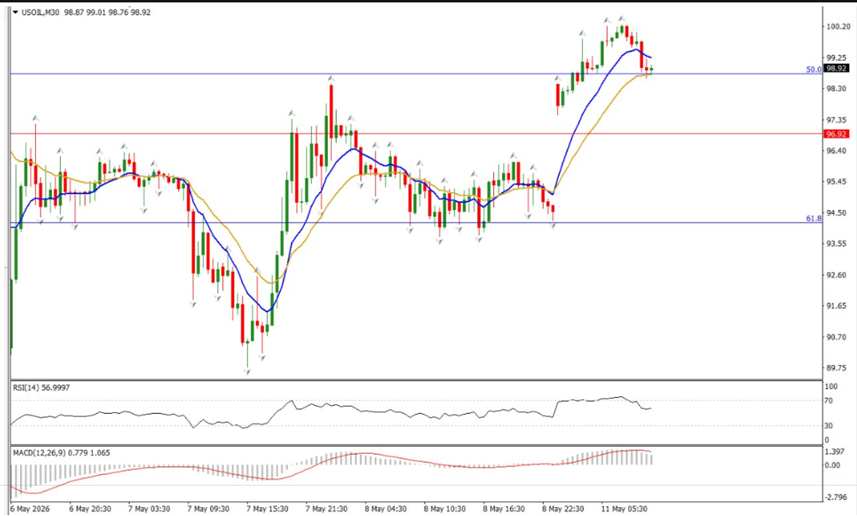
Geopolitical Risks Still Matter
Although AI remains the dominant market theme, geopolitical tensions continue creating underlying risk.
Although AI remains the dominant market theme, geopolitical tensions continue creating underlying risk.
Oil markets remain highly sensitive to developments in the Middle East and global energy supply concerns. Rising energy prices could reaccelerate inflation pressures and complicate the Fed’s policy outlook.
For traders, this means:
- Energy volatility may remain elevated
- Inflation-sensitive assets could react sharply
- Risk sentiment may shift quickly on headlines
- Energy volatility may remain elevated
- Inflation-sensitive assets could react sharply
- Risk sentiment may shift quickly on headlines
Trading Outlook for This Week
Bullish Scenario
Bullish Scenario
Markets may continue rallying if:
- CPI inflation cools
- Earnings remain strong
- AI spending guidance stays aggressive
- Bond yields stabilise
- Fed rate-cut expectations increase
- CPI inflation cools
- Earnings remain strong
- AI spending guidance stays aggressive
- Bond yields stabilise
- Fed rate-cut expectations increase
Under this scenario, semiconductor stocks could continue outperforming, with momentum traders likely targeting further upside in AI-linked equities.
Bearish Scenario
Markets could face a correction if:
- Inflation surprises higher
- Bond yields spike
- Earnings guidance disappoints
- Geopolitical tensions escalate
- Investors begin rotating out of overcrowded AI trades
Markets could face a correction if:
- Inflation surprises higher
- Bond yields spike
- Earnings guidance disappoints
- Geopolitical tensions escalate
- Investors begin rotating out of overcrowded AI trades
Given how extended semiconductor stocks have become, traders should remain cautious of sudden volatility spikes and aggressive profit-taking.
Technical Perspective
From a technical analysis standpoint, many semiconductor and AI-related stocks remain in strong uptrends. However, momentum indicators across several major names are beginning to show signs of overextension after the recent parabolic moves.
From a technical analysis standpoint, many semiconductor and AI-related stocks remain in strong uptrends. However, momentum indicators across several major names are beginning to show signs of overextension after the recent parabolic moves.
Traders should monitor:
- RSI divergence
- Volume exhaustion
- Gap-up reactions after earnings
- Nasdaq resistance zones
- Treasury yield movements
- RSI divergence
- Volume exhaustion
- Gap-up reactions after earnings
- Nasdaq resistance zones
- Treasury yield movements
Risk management becomes especially important in high-momentum environments like the current one.
Final Thoughts
The AI revolution continues driving one of the strongest market themes in years, and semiconductor companies remain at the centre of this transformation.
The AI revolution continues driving one of the strongest market themes in years, and semiconductor companies remain at the centre of this transformation.
However, this week introduces a critical test for the rally.
Inflation data, Federal Reserve expectations, earnings guidance, and geopolitical developments could all determine whether markets continue climbing or finally pause after weeks of aggressive gains.
For traders, the current environment offers major opportunities but also elevated risk.
Momentum remains strong, but volatility is likely to increase significantly around key economic releases and AI-related earnings announcements.
The next move in markets may depend on whether AI optimism can continue overpowering inflation fears and monetary policy uncertainty.
Publication date: