Oil Price Surges As Trump's Ultimatums Keep Markets On Edge. Forecast as of 23.03.2026
Author: Dmitri Demidenko Reviewed by Jana Kane
No matter what the US says about the conflict in the Middle East, the reality is that a resolution remains highly unlikely in the near term. At the same time, there are no clear signs of increased supply that could result from a potential easing of sanctions on Tehran. Let's discuss this topic and make a trading plan for Brent.
The article covers the following subjects:
- Major Takeaways
- Weekly Fundamental Forecast for Oil
- Weekly Trading Plan for Brent
- Major Takeaways
- Weekly Fundamental Forecast for Oil
- Weekly Trading Plan for Brent
Major Takeaways
- The US has issued another ultimatum to Tehran.
- Iran has complete control over the Strait of Hormuz.
- An escalation of the conflict could push oil prices up to $180.
- Long positions on Brent can be considered with targets of $125 and $130.
- The US has issued another ultimatum to Tehran.
- Iran has complete control over the Strait of Hormuz.
- An escalation of the conflict could push oil prices up to $180.
- Long positions on Brent can be considered with targets of $125 and $130.
Weekly Fundamental Forecast for Oil
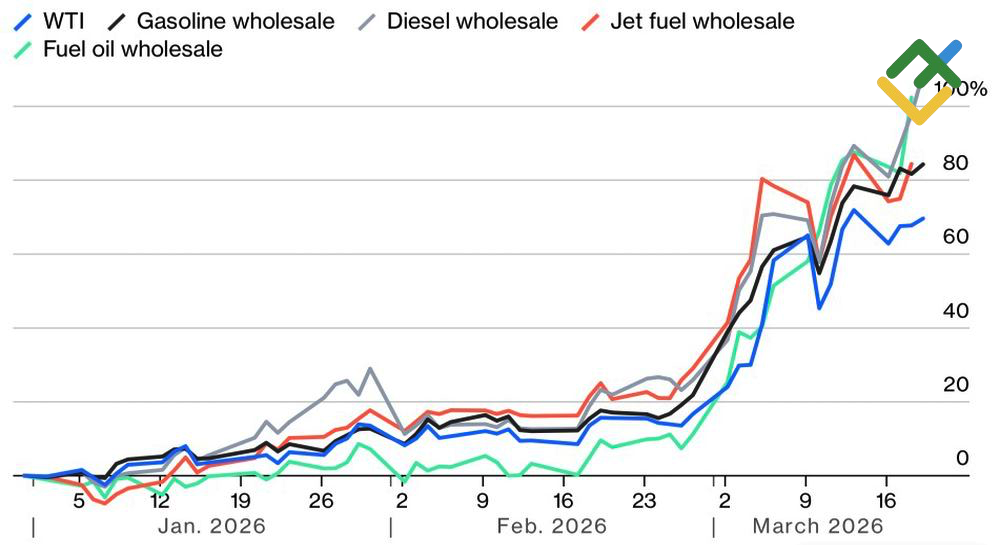
Donald Trump has painted himself into a corner after issuing a 48-hour ultimatum to Tehran to reopen the Strait of Hormuz and taking a hard line against Iran. Since then, oil prices have surged by 50–55%, while the cost of petroleum products critical to the US economy has jumped 85–120%. Saudi Arabia now sees Brent reaching $180 per barrel, while Goldman Sachs projects that Brent will average $110 in March–April, up 62% than in 2025.
Donald Trump has painted himself into a corner after issuing a 48-hour ultimatum to Tehran to reopen the Strait of Hormuz and taking a hard line against Iran. Since then, oil prices have surged by 50–55%, while the cost of petroleum products critical to the US economy has jumped 85–120%. Saudi Arabia now sees Brent reaching $180 per barrel, while Goldman Sachs projects that Brent will average $110 in March–April, up 62% than in 2025.
Oil and Petroleum Products Prices
Source: Bloomberg.
Donald Trump's extreme negotiating tactics have become widely understood, yet few have dared to challenge them—until now. Iran finds itself with its back against the wall, compelled to respond to any action with retaliation. Consequently, the US administration's threats to strike energy infrastructure prompted Iran to declare it would retaliate. Similarly, when the US president threatened to destroy the island of Hargah, and Israel acted, he had to intervene to halt further bombings.
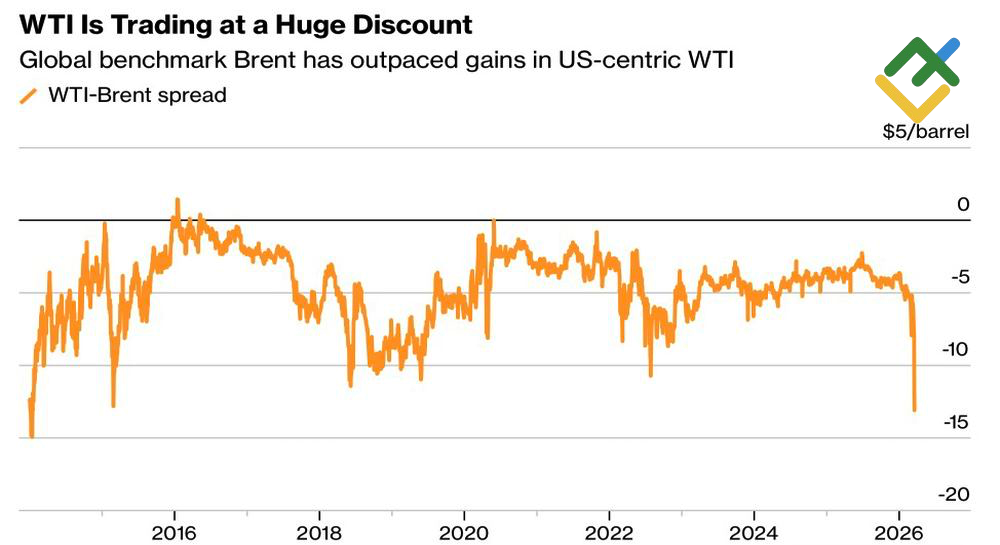
Despite the fact that the United States is in a far better position than other countries, it has no good way out of the conflict in the Middle East. Thanks to the US shale boom, the country has become a net exporter of energy products, and its oil reserves are growing, leading to the widest Brent–WTI spread in a decade.
WTI–Brent Spread
ource: Bloomberg.
What options does Washington really have? A ground operation would almost certainly send oil prices soaring. Meanwhile, Donald Trump has turned WTI into a barometer for his foreign policy. If the price is below $100 per barrel, everything seems “under control.” Yet it’s far from certain that the Marines could match Iran's massive military capabilities.
Withdrawing from the Middle East while claiming the stated objectives have been achieved would amount to a Pyrrhic victory that few would believe. Moreover, Donald Trump repeatedly promises the war will end soon, yet it continues. Treasury Secretary Scott Bessent has suggested that lifting sanctions on Iran could release 140 million barrels, while Tehran denies that it has unsold oil stored on tankers at sea.
Add to this the fact that an American withdrawal would leave Iran in full control of the Strait of Hormuz, where it already issues permits to Japan and determines which tankers can navigate the crucial waterway.
Weekly Trading Plan for Brent
The Goldman Sachs scenario—which predicts a six-week disruption of the world's key oil supply route followed by a return to normal within a month—is worth considering, and it would be wise to continue buying Brent on pullbacks. An escalation of the conflict in the Middle East will likely bring crude prices closer to the previously announced targets of $125 and $130 per barrel.
The Goldman Sachs scenario—which predicts a six-week disruption of the world's key oil supply route followed by a return to normal within a month—is worth considering, and it would be wise to continue buying Brent on pullbacks. An escalation of the conflict in the Middle East will likely bring crude prices closer to the previously announced targets of $125 and $130 per barrel.
This forecast is based on the analysis of fundamental factors, including official statements from financial institutions and regulators, various geopolitical and economic developments, and statistical data. Historical market data are also considered.
Publication date: