
Pound Rally Faces Headwinds from Energy and Political Uncertainty. Forecast as of 30.04.2026
Author: Dmitri Demidenko Reviewed by Jana Kane
The pound's gains amid the conflict in the Middle East appear questionable. The UK remains dependent on oil and natural gas imports, while upcoming local elections are adding to political uncertainty. Let's discuss these issues and develop a trading plan for the GBP/USD pair.
The article covers the following subjects:
Major Takeaways
Weekly Fundamental Forecast for Pound Sterling
Weekly Trading Plan for GBP/USD
Weekly Fundamental Forecast for Pound Sterling
Weekly Trading Plan for GBP/USD
Major Takeaways
- The pound rose due to soaring bond yields.
- The Labour Party may lose local elections.
- The Bank of England is bluffing with its repo rate hike.
- Short trades on the GBP/USD pair can be opened at 1.3520 and 1.3545.
- The pound rose due to soaring bond yields.
- The Labour Party may lose local elections.
- The Bank of England is bluffing with its repo rate hike.
- Short trades on the GBP/USD pair can be opened at 1.3520 and 1.3545.
Weekly Fundamental Forecast for Pound Sterling
The pound strengthened during the conflict in the Middle East, against both the US dollar and the euro. Although the UK is not an energy exporter, the GBP/USD pair benefited from rising global risk appetite and the increased appeal of UK assets. As a result, yields on UK bonds have risen faster than those of their counterparts. Rates on 30-year gilts are hovering near their highest levels since 1998.
The pound strengthened during the conflict in the Middle East, against both the US dollar and the euro. Although the UK is not an energy exporter, the GBP/USD pair benefited from rising global risk appetite and the increased appeal of UK assets. As a result, yields on UK bonds have risen faster than those of their counterparts. Rates on 30-year gilts are hovering near their highest levels since 1998.
30-Year Gilt Yield
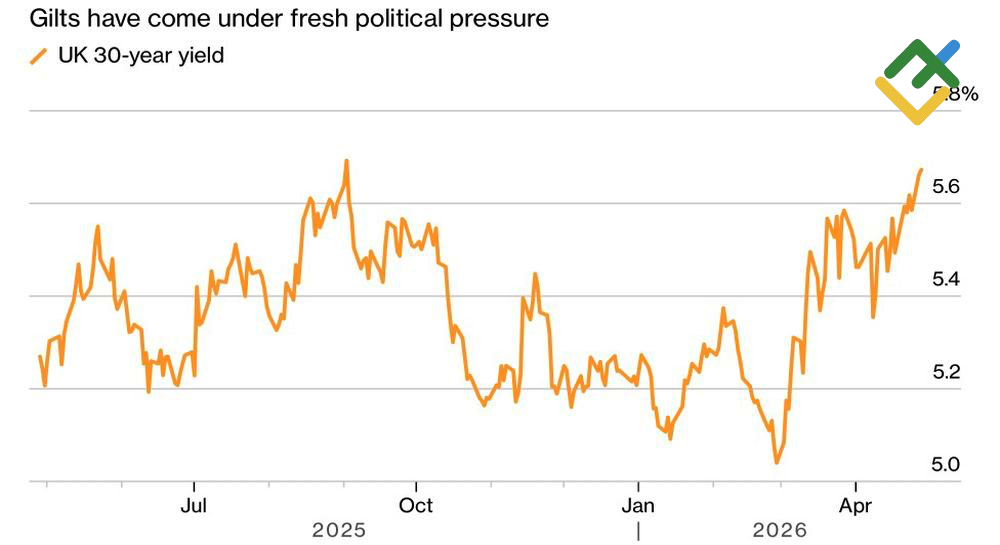
Source: Bloomberg.
Source: Bloomberg.
In reality, the recent sell-off reflects growing investor concern that inflation could accelerate to 5% amid the conflict in the Middle East and the resulting surge in oil prices. Futures markets are pricing in up to three rounds of monetary tightening from the Bank of England and more than two from the European Central Bank, while the Federal Reserve maintains a more cautious approach.
It is projected that on April 30, the Monetary Policy Committee will vote 8–1 to keep the repo rate at 3.75%, while revising GDP forecasts lower and inflation forecasts higher.
BoE Forecasts for Inflation and GDP
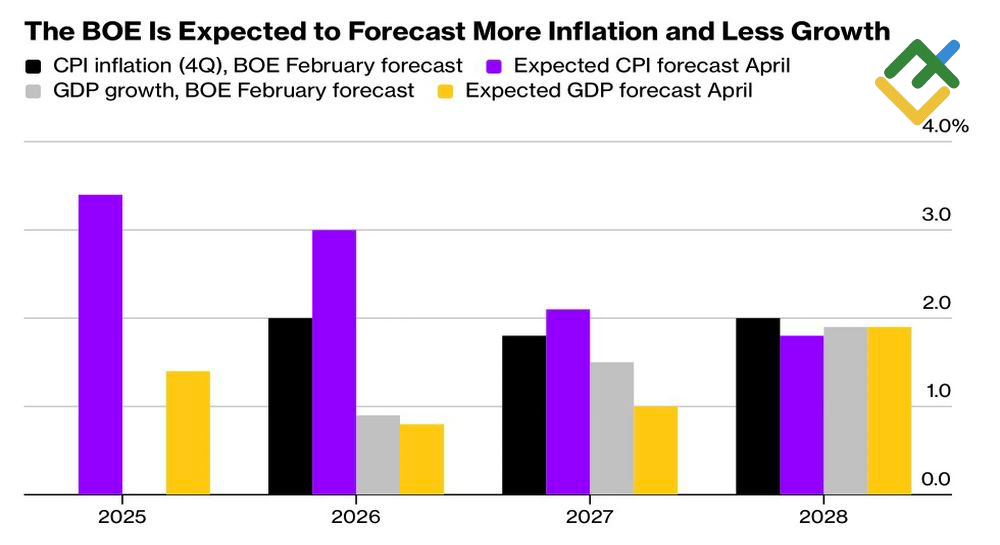
Source: Bloomberg.
Source: Bloomberg.
Prior to this, the National Institute of Economic and Social Research had revised its GDP forecasts downward from 1.4% to 0.9% for 2026 and from 1.3% to 1% for 2027.
Against this backdrop, tightening monetary policy becomes a double-edged sword. If it is used incorrectly, it can backfire.
At the same time, investors are more concerned about the upcoming local elections in the UK on May 7. This is evident from the faster growth in the pound's two-week volatility compared to its weekly and monthly volatility. The scandal surrounding the appointment of Keir Starmer as ambassador to the US is dragging down the Labour Party's poll numbers.
If the Labour Party loses, the risks of looser fiscal policy will increase. In addition, investors still recall the story of Liz Truss in 2022, when her government introduced a stimulus mini-budget against the backdrop of the BoE's monetary policy tightening. The result was a sharp sell-off in UK government bonds and a drop in the pound to record lows.
The GBP/USD pair looks vulnerable. Polymarket puts a 52% probability on the Strait of Hormuz being blocked by the end of June. In this connection, Brent may reach new all-time highs, benefiting currencies of net energy exporters, including the US dollar. The Bank of England is forced to resort to a hawkish bluff. The regulator is unlikely to increase the repo rate by 75 basis points to 4.5%. If we add political uncertainty, the pound's weakness will become plain to see.
Weekly Trading Plan for GBP/USD
The BoE's hawkish rhetoric following the April meeting should be used as a signal to sell GBP/USD on upward movements. In particular, if the pair fails to break through 1.352 and 1.3545.
The BoE's hawkish rhetoric following the April meeting should be used as a signal to sell GBP/USD on upward movements. In particular, if the pair fails to break through 1.352 and 1.3545.
This forecast is based on the analysis of fundamental factors, including official statements from financial institutions and regulators, various geopolitical and economic developments, and statistical data. Historical market data are also considered.
Publication date: