Pound Slips Amid BoE Caution and Rising Brent. Forecast as of 02.04.2026

While the futures market anticipates three Bank of England rate hikes in 2026, the regulator appears in no hurry to act. Instead, it is waiting for second-round effects to emerge in inflation. Let's discuss this topic and make a trading plan for the GBP/USD pair.
The article covers the following subjects:
- Major Takeaways
- Monthly Fundamental Forecast for Pound Sterling
- Monthly Trading Plan for GBP/USD
- Major Takeaways
- Monthly Fundamental Forecast for Pound Sterling
- Monthly Trading Plan for GBP/USD
Major Takeaways
- The outlook for inflation depends on the oil market.
- The Bank of England is weighing the risks.
- UK bond yields surged in March.
- Short trades on the GBP/USD pair can be opened with targets of 1.307 and 1.29.
- The outlook for inflation depends on the oil market.
- The Bank of England is weighing the risks.
- UK bond yields surged in March.
- Short trades on the GBP/USD pair can be opened with targets of 1.307 and 1.29.
Monthly Fundamental Forecast for Pound Sterling
Iran has warned that Donald Trump's rhetoric should not be taken at face value. However, both investors and central banks have no choice but to keep a close eye on any news from the Middle East. The timing of any resolution to the conflict is critically important, as it will shape the Bank of England's policy decisions and will directly influence the GBP/USD pair's trajectory.
Iran has warned that Donald Trump's rhetoric should not be taken at face value. However, both investors and central banks have no choice but to keep a close eye on any news from the Middle East. The timing of any resolution to the conflict is critically important, as it will shape the Bank of England's policy decisions and will directly influence the GBP/USD pair's trajectory.
Prior to the escalation involving Iran, the futures market was pricing in two rounds of monetary easing by the Bank of England in 2025. Developments appeared to be on track, with inflation slowing to 3% in February. In March, markets expected the Bank to cut its policy rate, but no move was delivered. In early April, futures markets were pricing in expectations of a 75-basis-point hike by the end of this year.
UK Inflation
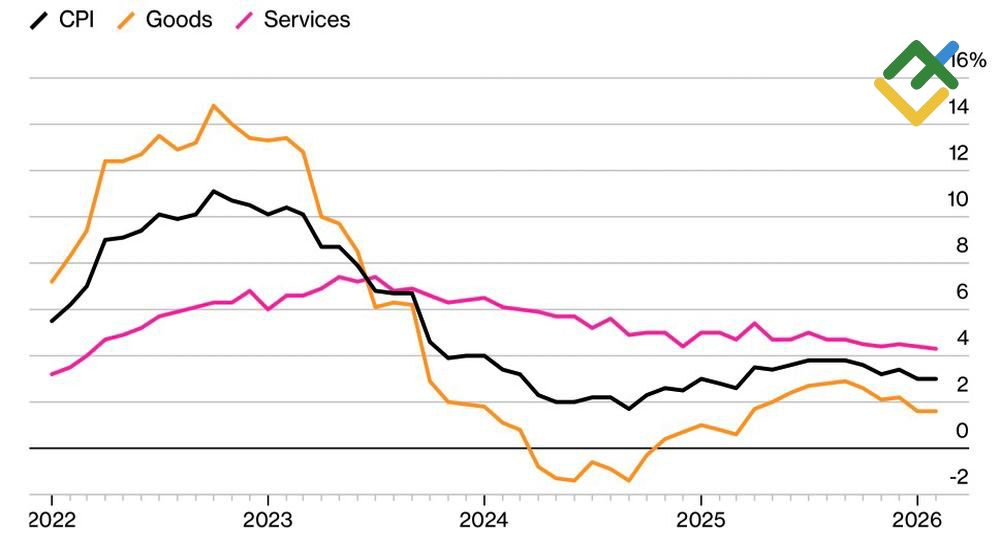
Source: Bloomberg.
Such forecasts seem overly dramatic. Indeed, rising oil prices due to the conflict in the Middle East will spur consumer prices. However, the BoE is more concerned with core inflation. It will not accelerate until workers, worried about rising CPI, start demanding wage increases. Second-order effects risk triggering an inflationary spiral. The longer the conflict lasts, the higher the chances of this happening.
For now, the Bank of England is seeking to temper investors' expectations with neutral rhetoric. MPC member Megan Greene was not inclined to raise the repo rate at the previous meeting. Similarly, Sarah Breeden emphasized the need for patience until second-round effects on inflation become clearer.
In reality, the Bank of England faces uncertainty over the correct policy course. It has two cautionary precedents. In 2022, the ECB was overly cautious for too long, and when inflation surged, it was forced into aggressive monetary tightening—an approach widely considered a mistake. Conversely, in 2011, the ECB responded quickly to rising consumer prices by raising rates, which significantly cooled the eurozone economy and necessitated a rapid reduction of borrowing costs to nearly zero.
It is always wise to learn from the mistakes of others. In my view, the ECB's misstep 15 years ago was more consequential than the one four years ago. The Bank of England should remain cautious—particularly given that the debt market, shaped by expectations of three rounds of monetary tightening, is effectively doing the regulator's job for it.
2-Year Gilt Yield
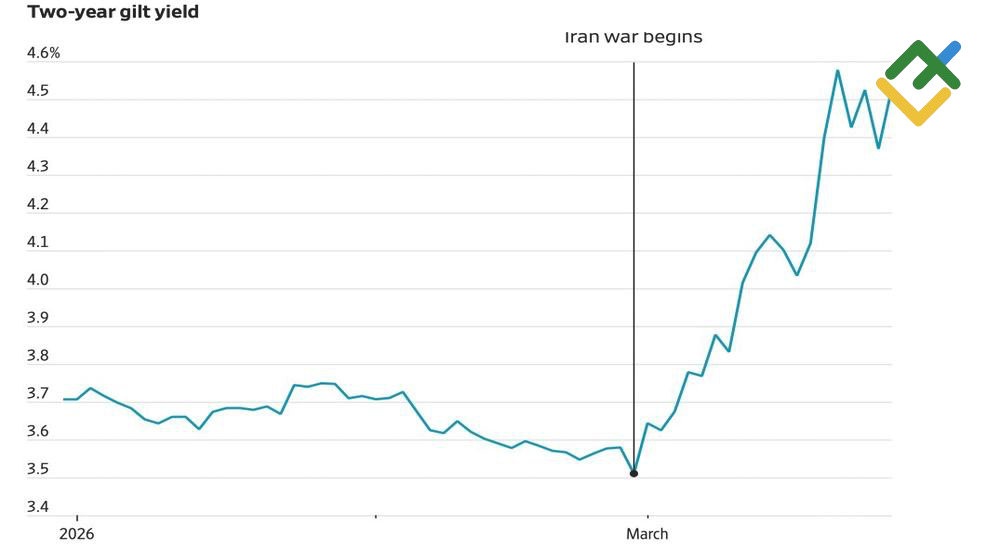
Source: Wall Street Journal.
In March, UK bond yields rose at their fastest pace since September 2022, when Liz Truss's government resigned. This recent increase in yields will help anchor inflation expectations.
Monthly Trading Plan for GBP/USD
The Bank of England is going with the flow, the direction of which is determined by the Middle East conflict. Short positions on the GBP/USD pair opened at 1.338 and 1.3355 can be increased as Brent quotes rise. The targets are 1.307 and 1.29.
The Bank of England is going with the flow, the direction of which is determined by the Middle East conflict. Short positions on the GBP/USD pair opened at 1.338 and 1.3355 can be increased as Brent quotes rise. The targets are 1.307 and 1.29.
This forecast is based on the analysis of fundamental factors, including official statements from financial institutions and regulators, various geopolitical and economic developments, and statistical data. Historical market data are also considered.
Author: Dmitri Demidenko
Reviewed by: Jana Kane
Reviewed by: Jana Kane
Publication date: