US Midterm Elections 2026: Will Stock Markets Rally or Fall?
The US midterm elections take place on Tuesday, 3 November, and investors are preparing for potential volatility across global financial markets. With control of Congress at stake, the outcome could influence government spending, regulation, and economic policy during the remainder of President Trump’s term.
However, historical data suggests that elections do not necessarily determine the longer-term direction of stock markets. In fact, the S&P 500 has demonstrated a remarkably consistent pattern of gains following previous midterm elections.
Could 2026 be different?
The S&P 500’s Remarkable Midterm Election Record
Since 1950, the S&P 500 has recorded positive returns in the 12 months following every US midterm election, with an average gain of approximately 15%, according to JPMorgan Asset Management.
Since 1950, the S&P 500 has recorded positive returns in the 12 months following every US midterm election, with an average gain of approximately 15%, according to JPMorgan Asset Management.
The six-month performance has also been historically positive, partly because political uncertainty tends to ease once election results become clear.
Investors generally dislike uncertainty surrounding taxation, government spending, and regulation. Once the political landscape becomes clearer, attention often shifts back towards corporate earnings, economic growth, and monetary policy.
However, historical performance does not guarantee future returns, particularly when market conditions differ significantly from previous election cycles.
Why the 2026 Elections Could Be Different
There are several reasons why this year’s elections could have a different impact on financial markets.
There are several reasons why this year’s elections could have a different impact on financial markets.
Firstly, US stock valuations are unusually elevated. The S&P 500’s cyclically adjusted price-to-earnings ratio currently stands near 40.7, substantially above its historical average of approximately 20.
Secondly, technology stocks have experienced significant selling pressure as investors question whether substantial investments in artificial intelligence will generate sufficient profits.
The NASDAQ 100 declined 3.5% on Friday, while the Philadelphia Semiconductor Index lost 7.2%, highlighting the vulnerability of technology companies to changing investor expectations.
Finally, geopolitical tensions involving Iran have pushed oil prices higher, increasing inflationary pressures and complicating the Federal Reserve’s monetary policy outlook.
These factors suggest that economic fundamentals could have a greater influence on stock market performance than the election results themselves.
How Could the Election Results Affect Financial Markets?
The composition of Congress could influence investor expectations regarding future economic policies.
The composition of Congress could influence investor expectations regarding future economic policies.
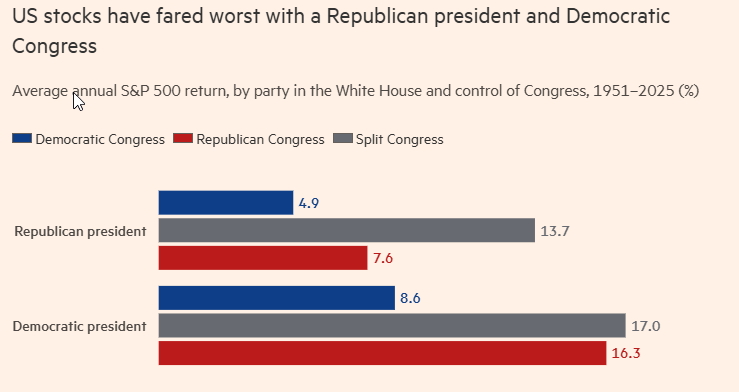
A divided Congress, where political control is shared between Republicans and Democrats, could make major legislative changes more difficult. Historically, this has sometimes coincided with stronger stock market performance because it reduces the likelihood of substantial policy shifts.
Alternatively, Democratic control of both chambers could result in greater legislative and regulatory scrutiny of the administration’s policies, potentially influencing government spending, technology companies, and the energy sector.
However, the relationship between political control and stock market performance is far from straightforward. Economic growth, corporate profitability, and monetary policy have historically played a more significant role in determining longer-term market trends.
What Could Happen to Gold, the Dollar and Oil?
The election results could influence several major financial assets, particularly if the outcome differs from market expectations.
The election results could influence several major financial assets, particularly if the outcome differs from market expectations.
Gold: Increased political uncertainty or a deterioration in risk appetite could support demand for safe-haven assets. However, higher Treasury yields and expectations of further Federal Reserve rate hikes could limit Gold’s potential gains.
US Dollar: The Dollar could react to changes in Treasury yields, fiscal policy expectations, and investor risk appetite. The direction will depend on how markets interpret the election outcome and its implications for economic growth.
Oil: Energy prices could remain particularly sensitive to developments involving Iran. Investors will be monitoring whether US foreign policy changes following the elections increase or reduce geopolitical risks.
US Stock Indices: The S&P 500 and NASDAQ 100 could experience increased volatility as investors reassess fiscal policy, AI regulation, and the broader economic outlook.
Importantly, these reactions are not guaranteed. Markets may have already priced in some potential election outcomes, reducing the impact of the actual results.
Market Outlook: Will History Repeat Itself?
The US midterm elections arrive at a challenging time for financial markets.
The US midterm elections arrive at a challenging time for financial markets.
Although historical trends suggest that equities often strengthen after midterm elections, elevated valuations, persistent inflation risks and uncertainty surrounding AI investments could challenge this pattern.
Investors will also be monitoring Friday's US Non-Farm Payrolls report, which could influence expectations for the Federal Reserve's December interest rate decision.
Ultimately, the elections could trigger short-term volatility, but the sustainability of any market rally will likely depend on corporate earnings, inflation, interest rates and geopolitical developments.
For traders, the important consideration is not simply which party controls Congress, but how the outcome changes market expectations and whether those changes are reflected in asset prices.
Publication date: